Get Full Government Meeting Transcripts, Videos, & Alerts Forever!
Get email alerts on the Homelessness Services topic
No spam. Unsubscribe anytime.
DaybyDay Shelter director details intake changes, partnerships and volunteer needs to Oshkosh DEI committee
Summary
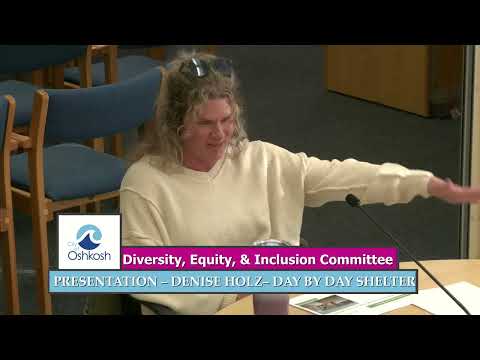
Denise Holtz of DaybyDay Shelter told the Oshkosh Diversity, Equity & Inclusion Committee on March 23 that the shelter moved in 2023 to a year-round 50-bed model with a structured intake, expanded programming and partnerships to help residents into housing; volunteers remain critical.
Denise Holtz, director of DaybyDay Shelter, told the Oshkosh City Diversity, Equity & Inclusion Committee on March 23 that the shelter has shifted from a seasonal, lottery-based model to a year-round, programmatic approach aimed at moving guests into stable housing.
Holtz said DaybyDay began in 2011 as a warming shelter and moved in 2023 into a permanent 50-bed facility, which required changing from a nightly lottery to an in-person waitlist and intake process. "Our current intake...is an in-person waitlist application," she said, describing a typical intake interview that lasts 45 minutes to an hour and a 90-day engagement period during which staff work with guests on individualized plans.
Why it matters: Committee members said the shelter’s approach addresses both immediate safety and the longer-term barriers to housing, including lack of affordable units and long wait lists for subsidized housing.
Holtz outlined who the shelter serves and key program elements: DaybyDay is open to adults 18 and over and operates as a wet shelter (allowing guests under the influence as long as they are safe), offers case management and health assessments developed in partnership with UWO, and provides a rent-smart certificate through UW Extension to help guests with rental history and budgeting. She reported an uptick among 18–24-year-olds and people 55 and older and said roughly "just under 400 individuals" were served in 2025 (exact 2025 totals not specified in the presentation).
Holtz described partnerships with Heads Up (transitional housing and mentoring), street outreach teams, health providers, Fox Communities Credit Union (budgeting support), and other community organizations. She said a recent grant allowed the shelter to pay first-month rent and security deposits for some guests — funding she called "majorly instrumental" in securing housing placements.
The shelter’s guest employment program hires four to five residents to help maintain the facility and rebuild work history. Holtz offered a success story of a former guest who regained employment at a private employer, secured stable housing and has remained sober. She also said DaybyDay provided more than 125 hours of counseling and completed over 90 health assessments in 2024, and delivered more than 1,000 hours of programming.
Holtz asked the committee for volunteer help year-round: meal teams, hospitality shifts, front desk coverage and laundry assistance. She provided a contact for volunteering and signups: the shelter’s volunteer and office manager, Jessica, via daybydayshelter.org. "If you want to help, definitely start online," Holtz said.
Committee members asked about facility features; Holtz described a quiet room used for de-escalation and private conversations and noted a two-way window was installed the opposite way, which guests view as giving them privacy. Members praised DaybyDay as a model and noted it may be among the first purpose-built shelters designed for homelessness in Wisconsin.
The committee did not take any formal action on funding or policy; Holtz’s presentation concluded with a request for continued community volunteer support and coordination with housing partners.
Next steps: Committee members suggested inviting housing department staff for a future update on city housing projects and continuing outreach around volunteer opportunities.