Get Full Government Meeting Transcripts, Videos, & Alerts Forever!
Get email alerts on the Healthcare Finance topic
No spam. Unsubscribe anytime.
Prime West Health CEO change, finances and fraud controls discussed with McLeod County commissioners
Summary
Prime West Health’s incoming CEO, Matt Magnus, told the McLeod County Board that Prime West serves about 75,000 members across 24 counties; the county-owned plan reported ~$751 million projected 2026 revenue, reserves of about $124 million and strengthened fraud-detection practices after recent transportation fraud cases.
Matt Magnus, introduced March 17 as incoming CEO of Prime West Health, briefed the McLeod County Board of Commissioners on the county-based purchasing model, enrollment, finances and fraud controls as he prepares to take the role June 1.
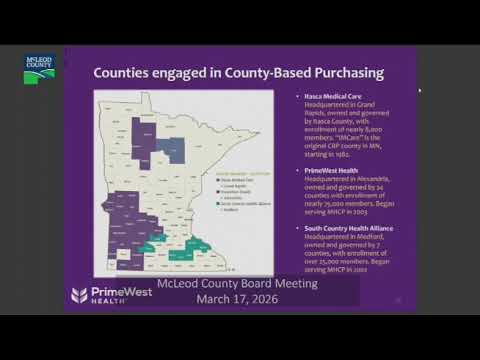
Prime West is a joint powers health plan owned by 24 counties that serves Medicaid and related public-program members in a largely rural service area. Magnus said Prime West serves about 75,000 members in 2026, with roughly 60,000 enrolled in Minnesota’s Medical Assistance (families and children). He described Prime West’s five primary contract lines—medical assistance, MinnesotaCare, Minnesota Senior Health Options (MSHO), Minnesota Senior Care Plus (MSC+) and Special Needs Basic Care—and explained the plan operates in a risk-based managed-care model paid largely by state and federal capitation.
On revenue and reserves Magnus said Prime West’s 2025 revenue included about $419 million from the state and roughly $71 million from the federal share (Medicare/dual eligible), with projected 2026 annual revenue of about $751 million and net worth (reserves) approximately $124 million. He noted Prime West returns community reinvestment grants and pays local providers above fee-for-service minimums in his counties, highlighting more than $26 million in grants and over $25 million paid above state fee-for-service rates historically.
Magnus addressed fraud concerns and Prime West’s response. He described an example of transportation-related fraud the plan detected, saying Prime West’s data monitoring identified sudden monthly spikes in transportation claims and the plan shut down providers and referred cases for legal action; he contrasted that with state-level fee-for-service systems and stated Prime West’s managed-care, data-driven controls allow quicker detection and response.
Commissioners asked about growth and administrative efficiencies. Magnus said the plan’s recent designation as the single plan for a major program added about 24,000 members with limited additional staffing (roughly 13 new staff) and helped reduce administrative expense ratios from about 7% toward a projected 5% in 2026. He said potential limited membership growth remains possible in gap counties but Prime West aims to support other county-based purchasers with third-party administrative services rather than expand uncontrolled board size.
Commissioners thanked Magnus for the briefing and congratulated him on stepping into the CEO role. Magnus’s presentation concluded with a discussion of Prime West’s local service footprint, claims turnaround (average seven days for providers) and commitment to rural provider networks.
The board did not take formal action on the presentation; commissioners expressed support for county-based purchasing and for Prime West’s continuation as a local resource.