Get Full Government Meeting Transcripts, Videos, & Alerts Forever!
Get email alerts on the Emergency Preparedness topic
No spam. Unsubscribe anytime.
City staff outlines emergency preparedness plan; YMCA, water storage and outreach singled out for next steps
Summary
Staff reported a year of preparedness work including 125 smoke alarms installed in 33 homes, a centralized MOU tracking system, planned community workshops and a site study for additional water-storage; the YMCA is being evaluated as a potential shelter.
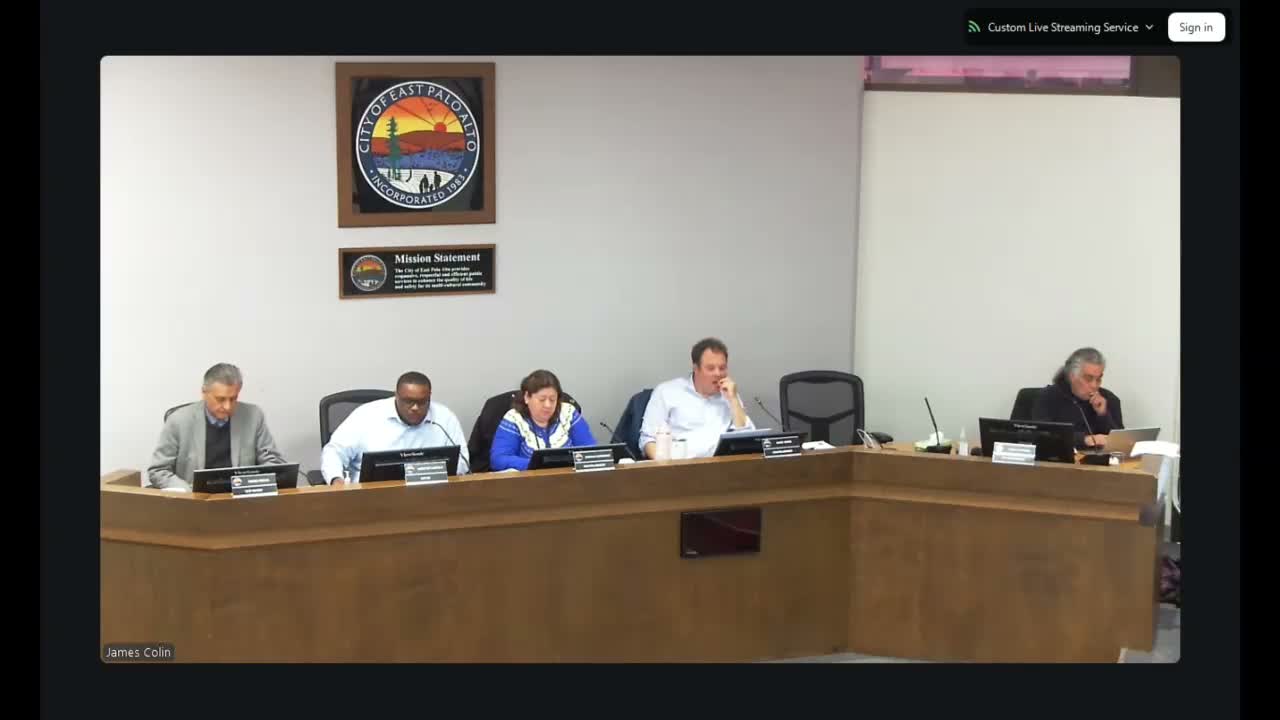
City staff on April 21 delivered an update on East Palo Alto—mergency preparedness, describing recent outreach, regional coordination and operational next steps.
Denise Garcia, assistant to the city manager, told the council staff coordinated with San Mateo County Emergency Management, Menlo Park Fire, Red Cross and local nonprofits to expand preparedness outreach, distribute materials, recruit CERT volunteers and provide multilingual workshops. Staff reported installing 125 smoke alarms in 33 homes through a Red Cross partnership and plans to distribute 145 resident emergency kits during upcoming workshops.
On sheltering, Garcia said staff surveyed the YMCA with Red Cross partners and are negotiating a formal shelter agreement to identify how many people the site could safely host; she emphasized shelter designations must account for pets and supplies. Council members pressed for estimated capacity; staff said final shelter numbers require Red Cross validation and will be included in the agreement.
The city is also studying additional water storage sites. Staff described an existing agreement with Sandhill Properties to install a 1,500,000-gallon water tank as part of a private development improvement (the Euclid Manhattan project), but noted that additional storage locations are still needed. Departments will complete continuity-of-operations plans, and the city plans to increase tabletop preparedness exercises to twice a year this year, rising to quarterly by 2028.
Menlo Park Fire Chief Mark Lorenzen briefed council on regional fire staffing and mutual-aid limitations, noting the district operates seven stations and roughly 35 personnel on duty on a given day; in a major earthquake, he said those resources would be overwhelmed and communities must plan for significant self-resiliency.
Public commenters asked about supply caches, neighborhood distribution of food and water and how shelters and schools could be used during regional events. Staff said they will return with more exact shelter capacity numbers, a crisis communication plan aligned with county frameworks and a one-year progress report on implementation.
Next steps: staff will finish the crisis communication draft in coordination with the county, finalize the YMCA shelter MOU by the end of the fiscal year, continue the site study for water storage and provide follow-up reporting to council.