Get Full Government Meeting Transcripts, Videos, & Alerts Forever!
Get email alerts on the Surveillance Alpr topic
No spam. Unsubscribe anytime.
Council keeps Flock ALPR program in place after heated public debate; status quo from December stands
Summary
After more than three hours of public comment and council debate, the City Council voted not to reauthorize a ban on the Flock ALPR program and left the December authorization in place, allowing the city manager to proceed with contract terms up to the previously authorized annual appropriation.
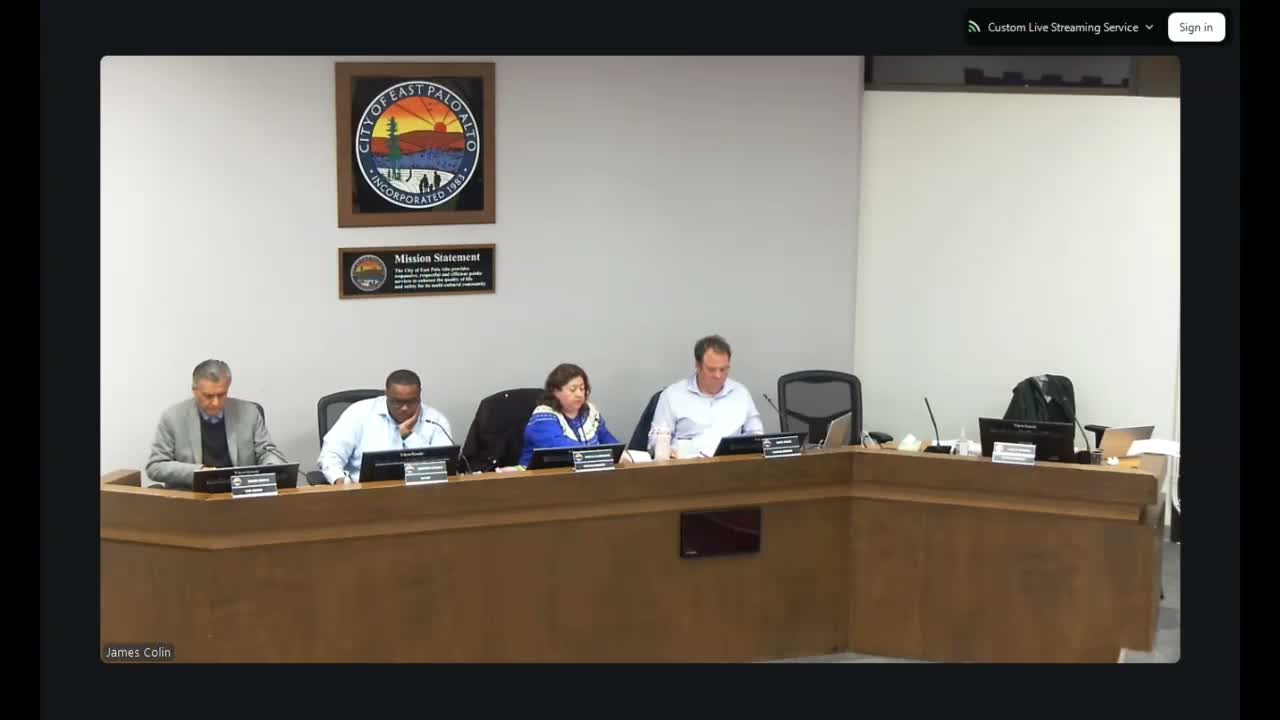
The East Palo Alto City Council on April 21th debated whether to end the city—ontract with Flock Safety, the automated license plate reader (ALPR) vendor, after an extended public-comment period that drew dozens of speakers both for and against the program.
Chief Liu, the city—hief of police, told the council the cameras have been "a very effective crime-solving tool," saying the system has helped identify suspect vehicles and accelerate investigations of serious incidents. He described the department's safeguards: mandatory case numbers and crime codes for searches, restricted approval authority, monthly public audits and a 30-day retention policy for ALPR data.
Opposition speakers — including Scott Herscher and many East Palo Alto residents and immigrant-rights advocates — urged the council to cancel the contract, citing documented data breaches in other jurisdictions, concerns about undisclosed third-party access and the risk that ALPR records could be exploited for immigration enforcement. "Run off the cameras. End the contract," one speaker said.
Councilmembers debated contract language and the city manager's ability to cancel without financial penalty. Several council members said they had understood earlier approvals to be month-to-month and were alarmed to learn that Flock's standard agreement could obligate the city to pay the remainder of a term if it cancelled "for convenience." The city manager and staff said negotiations focused on preserving the city's legal and financial protections and that language in earlier agreements differed from what was presented later in contract drafts.
Two competing motions were offered. Vice Mayor Bridal and others moved to deny reauthorization and direct the funds toward community-based policing alternatives; that motion failed in a roll call vote. A second motion, aligned with the December council authorization, returned the council to the prior status quo: the city manager retains authority to enter agreements up to the previously appropriated per-year amount, with staff reporting and audit requirements. The result effectively preserved the city's existing ALPR deployment and the staff udit regime.
Councilmember Romero pressed for one-year agreements and stronger cancellation language; other members argued multi-year software contracts are common practice but acknowledged the community—oncerns and the need for continued transparency. The council directed staff to continue publishing audits and to ensure the city's transparency portal reflects current sharing arrangements.
The council's debate and the large public turnout underscored deep divisions in East Palo Alto over balancing investigatory tools with privacy and civil-liberty concerns. The council did not adopt a policy change to end ALPR use; instead it left in place the prior authorization while directing continued public reporting from the police department.
Next steps: staff will continue quarterly reporting to the council and maintain public audit logs; councilmembers discussed additional options for revisiting contract terms and for allocating resources to community-based alternatives.