Get Full Government Meeting Transcripts, Videos, & Alerts Forever!
Get email alerts on the Municipal Budgeting topic
No spam. Unsubscribe anytime.
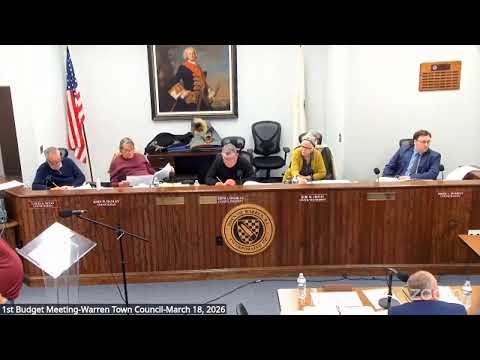
Warren council begins budget hearings, approves department expense lines and flags $325,000 accounting correction
Summary
At its first public budget hearing, the Warren Town Council approved multiple department expense totals, directed staff to annotate large variances and accepted a $325,000 correction that reduced the employee-benefits line after finance staff found employee co-shares recorded as receivables.
The Warren Town Council opened its first public budget hearing by reviewing the operating, capital and revenue books and approving a string of departmental expense totals while asking staff for clearer notes on large percentage changes.
Council members heard an overview from Mr. Rego and finance staff before moving through department-by-department reviews. The council recorded approvals by voice vote on several department totals, including the town-clerk expenses ($452,528), finance/assessor and town-council lines, and shared-services totals. Multiple motions were seconded and carried by simple voice votes during the hearing.
Finance staff reported a material accounting correction during the meeting: payroll-related employee co-shares previously recorded to a receivable account were reallocated to employee benefits, reducing that line by about $325,000 to a new budgeted figure of $1,943,411. A council member made and the body approved a motion to adjust the employee-benefits line to reflect the corrected figure.
Members repeatedly asked staff to add short explanatory notes where budget lines exceed 4–5 percent, citing several examples of apparent large percentage changes that were caused by internal reclassifications rather than new spending. Where money had been moved between part-time and full-time lines (for example, the animal-control officer), councilors asked staff to add footnotes explaining the shifts so percentage columns on the printed sheets reflect the figure the council originally approved rather than mid‑year transfers.
The council also continued the public-works department review to the next budget hearing to allow staff time to reclassify transactions and provide clearer line‑item histories. The meeting closed with a direction that staff provide a reconciliation of grant and special‑revenue balances used to offset operating costs (for example, police overtime reimbursements) and a monthly monitoring plan for sewer fund revenues and capital repayments.
The hearing will reconvene next week to finish department reviews and finalize revenue figures; staff said they will return with revised sheets and annotated explanations for the council’s next vote.