Get Full Government Meeting Transcripts, Videos, & Alerts Forever!
Get email alerts on the Wmp Updates topic
No spam. Unsubscribe anytime.
Stakeholders favor trigger‑based WMP updates, urge change‑order flexibility
Summary
Workshop participants recommended replacing automatic annual WMP updates with a trigger‑based or change‑order approach tied to events such as GRC decisions, EUP outcomes, risk‑model updates, or catastrophic wildfires, and advocated cumulative targets to reduce mid‑cycle disruption.
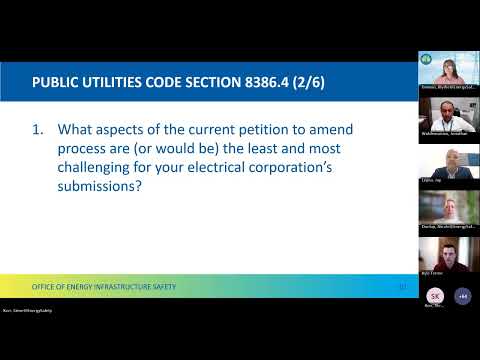
After a short break, Energy Safety turned to how Wildfire Mitigation Plans should be updated mid‑cycle now that SB 254 removed the agency’s express statutory authority to require routine updates. Blythe Denton explained the agency seeks input on whether to adopt a trigger‑based approach, change‑order mechanism, or a different update cadence.
Multiple utilities supported moving away from an automatic annual update toward submissions driven by defined triggers. One participant suggested creating a list of triggers—GRC filing, a risk‑model update, EUP decision, or a catastrophic wildfire—that would justify a WMP update; another recommended a change‑order pathway for significant strategic shifts.
Speakers raised practical examples. A PG&E representative said rigid update criteria previously prevented target changes when asset registries changed (for example, sold or decommissioned substations) and noted evolving approaches such as continuous monitoring could warrant mid‑cycle revisions. As the speaker put it, some asset registry changes are “nuance…we aren't able to change our WMP target due to asset registry changes, which are asset registry changes all the time.”
Panelists also discussed the Electrical Undergrounding Plan (EUP) and Climate Adaptation Vulnerability Assessments as potential triggers; Jay (PG&E) said his company would assume an EUP will be approved when planning WMP submittals unless a decision dictates otherwise. Many participants favored cumulative targets over strictly annual targets so utilities can rebalance work across a four‑year cycle without repeatedly reopening the WMP.
Energy Safety asked stakeholders to provide homework examples (a hypothetical crosswalk) and to submit written comments; the agency reiterated the docket comment deadline of 05/14/2026 and said it will consider submissions as it drafts new guidelines.