Get Full Government Meeting Transcripts, Videos, & Alerts Forever!
Get email alerts on the Small Business topic
No spam. Unsubscribe anytime.
Council introduces sidewalk-vending ordinance, funds vendor support pilot and asks staff to set affordable fees
Summary
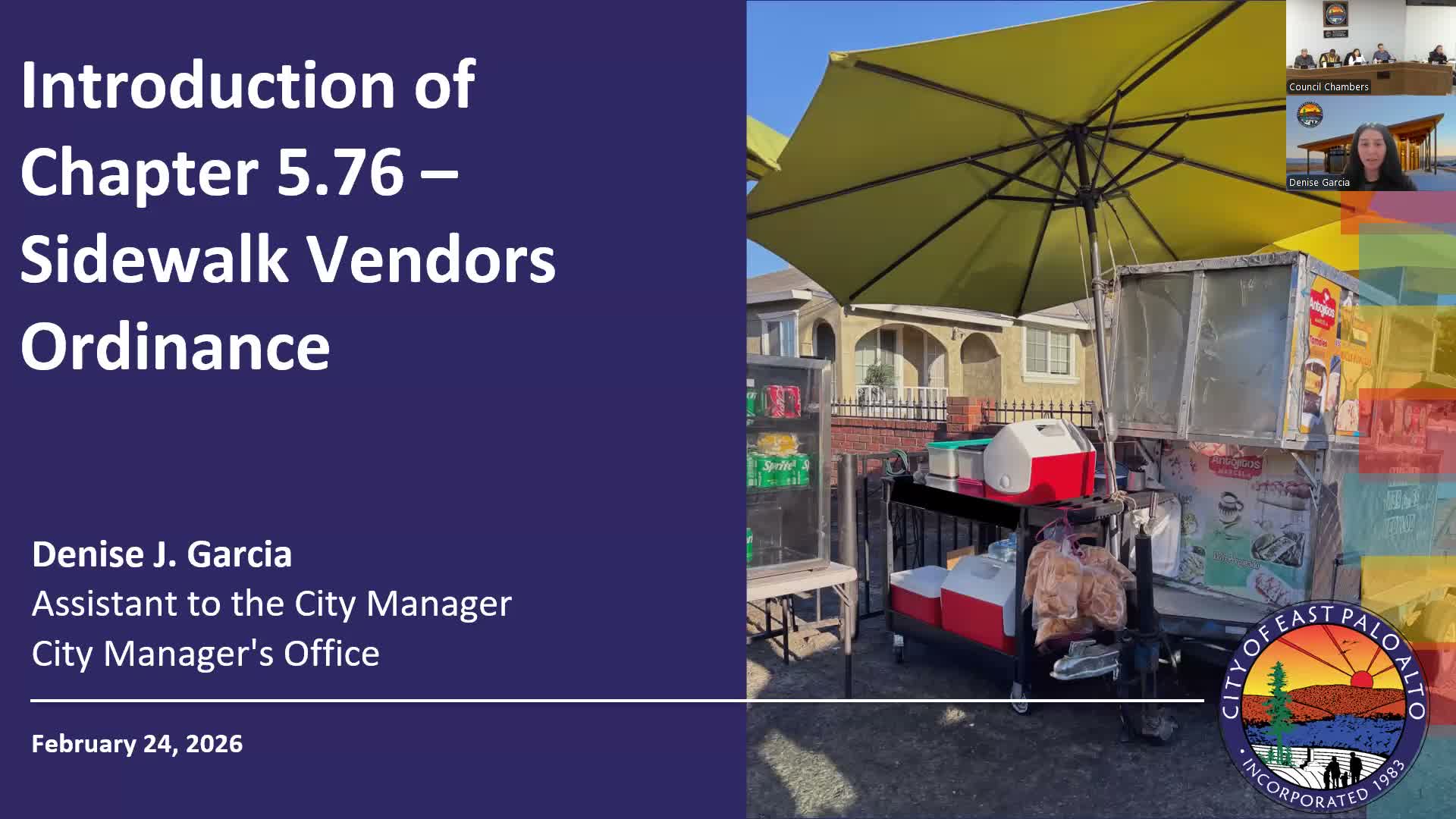
Council introduced a sidewalk-vending ordinance that creates a permit system with education-first enforcement, a vendor-support pilot (training and financial assistance), bilingual permitting help and visible permit cards; council asked staff to return with a scaled insurance/indemnity approach and to set affordable fees and hours by regulation.
The council considered an updated sidewalk-vending ordinance implementing state sidewalk-vending law (CMFO rules) with additional local controls: permit cards, bilingual assistance in permitting, minimum trash/cleanup obligations, ADA clearance and a two-warning enforcement approach before administrative fines. Staff proposed a vendor-support pilot that pairs technical training (Renaissance Entrepreneurship Center) with financial assistance to offset county food-permit fees and equipment costs for vendors seeking to become fully permitted.
Vendors and community members provided detailed public testimony. Vendors asked for lower fees, flexible hours (market activity in early morning and evening), and technical and financial assistance; several proposed central "vendor park" locations where multiple vendors could operate. Some residents urged protective rules (limits in residential areas, distance from driveways and noise controls). The city attorney and staff discussed litigation in other jurisdictions over insurance and indemnity; public-counsel recommendations to keep fees affordable and consider indemnity (but possibly not an insurance requirement) were noted.
Council action: after extended public comment and discussion the council introduced the ordinance and directed staff to: (1) return with a fee resolution and a scaled approach to insurance/indemnity that preserves vendor access; (2) set permitting hours and other nuts-and-bolts by regulation (city manager authority) so the council can adjust details without re-adopting ordinance language; and (3) proceed with the vendor-support pilot-funded technical assistance and partial equipment/permitting subsidies. The council emphasized education-first enforcement and ongoing monitoring and review.
Next steps: staff will draft a fee schedule, propose tiered insurance/indemnity options, coordinate with county health on permit-fee realities, implement bilingual permitting assistance and return to council for final adoption of fees and operational guidelines.