Get Full Government Meeting Transcripts, Videos, & Alerts Forever!
Get email alerts on the Economic Mobility topic
No spam. Unsubscribe anytime.
Panel debates whether economic mobility hinges on individual action or structural change
Summary
At a Columbus Metro Club forum, panelists debated whether economic mobility is chiefly driven by individual choices and community action or by structural forces such as concentrated corporate power, fragile safety nets and underfunded programs. The discussion highlighted local workforce programs, Piney Woods’ community model and the role of employers and civic engagement.
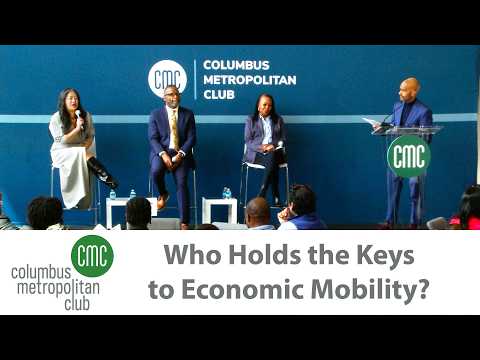
A Columbus Metro Club forum at the National Veterans Memorial Museum brought together Dr. Joyce Chen of The Ohio State University, Will Crosley of the Woodson Center and Stephanie Hightower of the Columbus Urban League to debate what drives economic mobility.
Moderator Rodney Dedigan opened the conversation by asking whether families, neighborhoods, employers, government, schools or civic institutions “hold the keys” to opportunity. Stephanie Hightower responded, “We all hold the keys,” arguing that everyone from families to funders must act and that many nonprofit staffs who help others succeed are paid too little to do that work effectively. Hightower described programs that pair training with supports such as stipends, childcare and transportation and said those supports are essential for participants to succeed.
Will Crosley emphasized the power of local, community-driven solutions and offered Piney Woods — a rural, hands-on school and farm program he described as producing high college-attendance rates — as an example of a sustainable model built outside of relying solely on government. “Where a student and a teacher are seated on a fallen log, therein lies a school,” Crosley said, describing how community institutions can create durable pathways regardless of political changes.
Dr. Chen pushed back on a strictly individualist framing by pointing to structural barriers. She warned that increasing concentration of market power among major corporations and the prevalence of precarious work that carries no benefits can make individual steps insufficient. “Those systems are designed to continue impoverishing people,” Chen said, urging attention to how labor classification, childcare and other public goods are organized.
The panel debated practical tradeoffs. Crosley invoked the “success sequence” (finish school, secure full‑time work, marry before having children) as a set of actions associated with lower poverty risk, while Chen cautioned that social‑science correlations are not always causal and that policy should address systemic frictions — for example, how a flat tire or a broken furnace can cascade into job loss without accessible safety nets.
Hightower described employer partnerships and an Urban League trades program funded by the Franklin County Commissioners that provides training plus supportive services and stipends; she said such wraparound support has improved placement and retention. Chen suggested policy levers — including tax and estate policy — to circulate capital more broadly, and Crosley warned that government action can be unstable and must be complemented by resilient community capacity.
The forum concluded with an audience Q&A that pushed on employer engagement, wealth redistribution and housing (details appear in a companion report of audience questions). Panelists urged a mix of private fundraising, civic engagement and policy action, and emphasized that both community programs and public policy have roles to play.
The Columbus Metro Club said the conversation would continue at upcoming forums and encouraged civic leaders to pursue a mix of immediate supports and long‑term systemic reforms.