Get Full Government Meeting Transcripts, Videos, & Alerts Forever!
Get email alerts on the Land Use Geologic Hazards topic
No spam. Unsubscribe anytime.
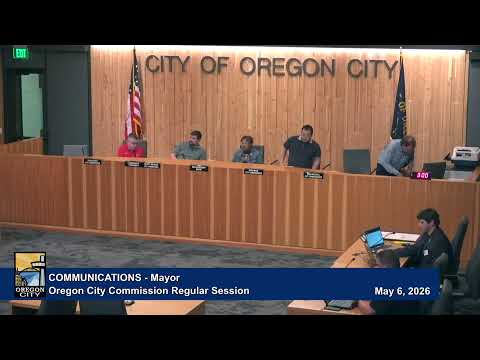
Oregon City Commission sides with developer in landslide‑buffer appeal, overturns planning commission 4–1
Summary
The city commission voted 4–1 on May 6 to uphold an appeal by developer Cyprus and adopt a discretionary interpretation of OCMC 17.44.060(L) that allows case‑by‑case engineered solutions inside the 200‑foot geologic‑hazard buffer, directing staff to draft modified written findings for approval June 3.
Oregon City’s commission voted 4–1 on May 6 to uphold an appeal by developer Cyprus and adopt an interpretation of municipal geologic‑hazard rules that permits case‑by‑case discretionary approval of engineered mitigation measures inside the city’s 200‑foot geologic‑hazard buffer.
The appeal concerned the planning commission’s April 13 decision approving a master plan and detailed development plan for a project at 1367 Wallowa Avenue, subject to conditions limiting disturbance in mapped landslide and steep‑slope buffers. Staff and the planning commission had relied on a conservative reading of OCMC 17.44.060(L), which the city’s assistant city engineer, Josh Wheeler, summarized as a provision that, "This does not allow any type of variance as desired by the applicant." Wheeler explained staff’s view that the phrase "as provided in this chapter" points back to fixed buffer standards and a 4,000‑square‑foot disturbance threshold.
The applicant, represented by attorney Greg Hathaway, urged the commission to adopt the city attorney’s alternate "option 2" interpretation that would give the review authority discretion to determine whether proposed geotechnical remediation methods render a hazardous site safe for development. "We’re asking this evening for your city commission to adopt your city attorney’s option 2," Hathaway said, arguing that staff had changed its position after earlier recommendations and that the developer relied on prior staff guidance.
Project engineers told the commission their proposed retaining‑wall system and drainage work would stabilize historic shallow landslides. "Our proposed development would make this site and the surrounding properties safer than they are today," said Kirk Williams, the project’s managing director, adding that both the city’s geotechnical consultant and the applicant’s geotechnical team agreed engineered mitigation could reduce risk.
Commission discussion centered on whether subsection L gives the review authority — and on appeal the city commission — discretion to allow exceptions if specific findings are made. Commissioners who supported the appeal said the text permits case‑by‑case determinations and that engineered solutions satisfy the code’s public‑safety purpose if the city’s geotechnical engineer concurs. Staff cautioned that an interpretation allowing broad discretion could conflict with the objective standards adopted in 2021 to evaluate residential development.
Commissioner Scott Wilson moved to approve the appeal; the motion passed 4–1 on a roll‑call vote (Rocky Smith, Scott Wilson, Adam Marl, Mike Mitchell voted Aye; Mayor Denise McGriff voted No). Following the vote the commission authorized staff and the applicant to collaborate on drafting modified written findings and set a June 3 meeting to approve the written findings; staff also noted a short extension of the 120‑day deadline to allow for that work.
The decision reverses the planning commission’s approach on a key code interpretation and leaves open further review: the written findings must state the legal basis for the commission’s interpretation, specify required geotechnical conditions, and identify how the city will verify that any mitigation measures satisfy safety standards.