Get Full Government Meeting Transcripts, Videos, & Alerts Forever!
Get email alerts on the Business License Reform topic
No spam. Unsubscribe anytime.
Chino council directs staff to study variable business‑license tax model and compliance plan
Summary
After a consultant presentation showing Chino’s business-license tax is decades out of date, the council asked staff to study a variable gross‑receipts model, strengthen compliance (including online registration) and assess ballot timing for a November 2026 measure.
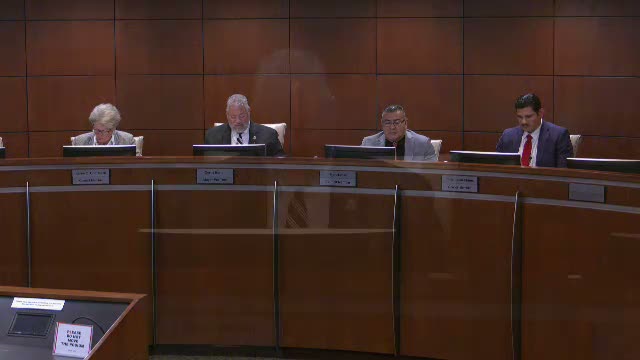
A majority of the Chino City Council on Tuesday voted to direct staff to further study a variable gross‑receipts business‑license tax model and to pursue feasibility work for a possible November 2026 ballot measure.
The action follows a staff presentation and consultant analysis from Eric Myers of HDL Companies showing Chino’s business‑license code has not been substantially updated since 1987 and yields relatively low revenue per capita compared with peer cities. Myers outlined two broad approaches: a single flat gross‑receipts rate and a variable rate that charges different gross‑receipts rates by business category. Staff recommended the variable model as more equitable and able to address how current caps favor some large businesses.
Why it matters: Council members and attendees said revenues from the tax support general‑fund services and have not been reviewed in decades. Council members also raised concerns that an unknown share of businesses in Chino operate without licenses; staff estimates 8–10% noncompliance and had separate work underway to identify and notify unlicensed businesses.
Key details: Myers said the city currently has about 4,656 licensed businesses and that an estimated 10–15% may be operating without licenses. Under the consultant’s models, a modest single gross‑receipts rate (about $0.45 per $1,000) could raise roughly $3.6 million annually; higher-rate options and some variable models could raise materially more, depending on rates and caps. The variable model example presented projected roughly $4.8 million in additional revenue while addressing equity across business types.
Council questions focused on enforcement and equity. Council members pressed staff on how many revenues might be recoverable from currently unlicensed firms, how warehousing/distribution operations would be treated, and whether businesses with multiple activities (for example, a dealership with on‑site repair) would face multiple classifications. Eric Myers and staff said the feasibility phase would address classification, capture of warehousing activity, and how to implement online registration to increase compliance.
The motion: Council voted (4–0, mayor absent) to approve staff’s recommendation to pursue a variable gross‑receipts model, continue concurrent compliance work to identify unlicensed businesses, and return with feasibility and ballot‑timing details. The council asked staff to prepare ordinance language and a draft ballot reference so the registrar’s deadlines can be met if a measure is pursued.
What’s next: Staff will continue work on compliance outreach and technical feasibility for the variable model, then return with recommended ordinance language, revenue estimates and a proposed timeline for ballot placement if the model proves viable.