Get Full Government Meeting Transcripts, Videos, & Alerts Forever!
Get email alerts on the Parking Implementation topic
No spam. Unsubscribe anytime.
Nashville residents and businesses fault NDOT for unannounced Lindsley/Middleton parking changes; commission orders fixes
Summary
Dozens of residents and small businesses told the Traffic & Parking Commission that time‑parking and paid parking signs went up with little notice on Lindsley and Middleton; NDOT acknowledged implementation and communication errors, said it will pause strict enforcement, send new public flyers, consider extending time limits to four hours, and brief the commission again.
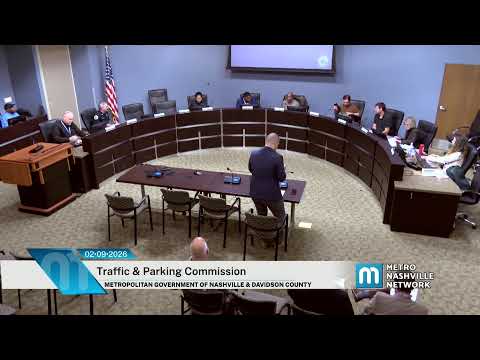
Dozens of residents, business owners and nonprofit leaders told the Traffic & Parking Commission on Monday that recent parking changes on Lindsley and Middleton avenues were imposed with inadequate notice and have harmed workers, clients and operations.
"The parking signs were installed around our business literally in the dark of the night, with 0 notice and 0 public process," Neely Glenn, co‑owner of The Cordell event venue, told the commission during the public‑comment period. "This isn't just an inconvenience — it is a safety concern."
The hearing, which drew multiple speakers from the 12 South neighborhood and businesses that serve visitors, centered on two related problems: (1) time‑limited and paid parking that residents and venue operators say was implemented without adequate outreach, and (2) the timing mismatch between installation of street signs and activation of off‑street facilities intended to absorb displaced parking.
NDOT staff acknowledged the department's role. "When the Howard lot installation was delayed, it just broke down the cohesion," Emmanuel Matias, an NDOT operations manager, told the commission. He said an earlier internal policy had not required outreach flyers for time‑parking, that a small number of live citations were mistakenly issued during the soft‑enforcement period, and that NDOT has updated its procedure to require two flyers going forward (one engagement notice before installation and one notification after approval).
Matias listed near‑term remedies already under consideration: backing signs while staff coordinates rollout, continuing an education‑first enforcement posture (warning citations rather than payable tickets), expanding outreach on the city's website, and testing a longer limit (extending some Lindsley time parking from two hours to four hours) to accommodate longer business visits and training sessions.
Business owners and service providers described concrete harms. "Most of my staff cannot afford to live in the city that they serve," said Neely Glenn, noting employees now must walk farther, sometimes through isolated areas, after signs were posted. Chandra Watson and Leah Watson — event‑space owners who said signs were posted seven months after the commission's earlier vote — told the commission the delay prevented many in the community from using the 60‑day appeal window.
Council member Tom Cash (18th District), who spoke at the meeting, framed the items as part of a larger 12 South parking plan that should include RPP zones, geofencing, shared loading, striping and consistent rules for visitor allowances. Several commissioners urged NDOT to make public the inputs to its planning tools and to coordinate more clearly when phased changes (lots, curb use, time parking) are meant to launch together.
What NDOT will do next: Matias confirmed a community meeting scheduled the next day (750 South 5th, 2:00 PM) and promised to provide the commission with an update at its next monthly meeting. Commissioners also requested NDOT produce clearer web notices and to provide documentation of petition counts and RPP application details as the RPP‑code revisions move through legal review.
Votes at a glance from the meeting: the commission approved several consent and regular items affecting parking and loading (consent items 5.1, 5.5 and 5.6 were approved; residential permit parking petitions pulled from consent were approved after discussion; a 24/7 loading zone replacing an abandoned valet lane at 601 12th Ave S was approved). The commission also directed NDOT to continue soft enforcement on Lindsley/Middleton while outreach and rollouts occur.
Why it matters: Small businesses, event venues and nonprofits say the current implementation has immediate economic and safety effects — from lost customers and bad reviews to staff walking longer distances after late shifts. NDOT's commitment to new notification steps and a controlled rollout aims to reduce those harms, but several commissioners pressed for measurable follow‑ups to ensure the changes do not simply shift problems to adjacent blocks.
The commission asked NDOT to return with a written update and to share study inputs, petition counts and revised RPP application material in coming meetings.