Get Full Government Meeting Transcripts, Videos, & Alerts Forever!
Get email alerts on the Public Safety Alpr topic
No spam. Unsubscribe anytime.
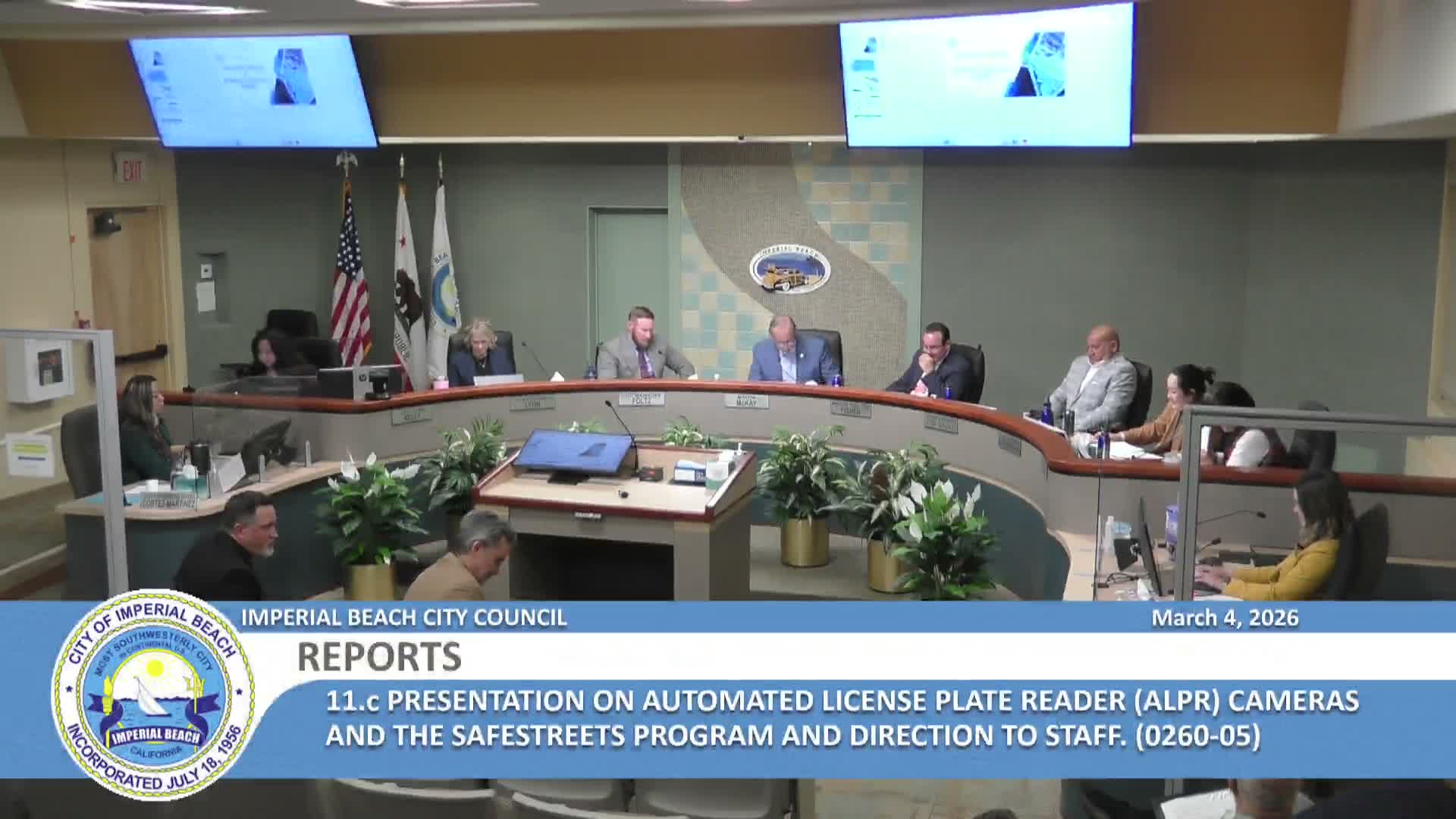
Council hears sheriff's Safe Streets and ALPR briefing, asks staff to return with costs and locations
Summary
The San Diego County Sheriff's Office presented the Safe Streets camera registry and automated license plate reader (ALPR) systems; council directed staff to assess costs, locations and return with a proposal after public concerns about cost and permitted uses were raised.
The City Council received a presentation on March 4 from the San Diego County Sheriff’s Office about the Safe Streets program and automated license plate readers (ALPRs), and instructed staff to return with a financial preview and proposed camera locations.
Lieutenant Galvey (San Diego County Sheriff’s Office) described Safe Streets as a registry that allows homeowners and businesses to pre‑identify cameras that law enforcement may contact when investigating crimes. He explained business systems can be federated to give authorized sheriff staff direct access to live public‑facing video, while home registrations remain request‑driven. "This is a request driven process," the lieutenant said, adding that the registry does not give live streaming access to deputies by default.
The sheriff’s presentation also explained ALPR technology and local experience using Flock Safety systems. The presenter said each Flock ALPR camera costs about $3,000 per year with a $150 installation fee, data are retained for 30 days unless preserved for an investigation, and access is limited to trained personnel; the sheriff’s office noted there are currently no ALPRs or public safety cameras installed in Imperial Beach and two home cameras are registered with Safe Streets.
Public commenter Carl Bradley asked for itemized installation cost estimates and said draft MOU language that used broad phrasing such as "including but not limited to" could permit uses beyond the community’s intent. "I want my city and I want the community to know exactly how much this installation is gonna cost us before the city goes forward with any sort of adoption of MOUs," Bradley said.
Council members asked technical questions about cybersecurity, monitoring and deployment strategies (hot‑spot versus perimeter coverage). Multiple members asked staff to come back with a two‑part analysis — one for the Safe Streets registry and one for ALPR procurement — including proposed locations, an estimate of how many cameras could be purchased with money set in the city budget, and reporting metrics to evaluate public benefit.
The council received the report and gave staff direction to prepare a financial preview, proposed placements, and separate implementation plans for the Safe Streets registry and any ALPR pilot or deployment for future consideration.