Get Full Government Meeting Transcripts, Videos, & Alerts Forever!
Get email alerts on the Sewer Rates topic
No spam. Unsubscribe anytime.
Imperial Beach council adopts sewer-rate ordinance to shore up sewer fund, pick Option 1
Summary
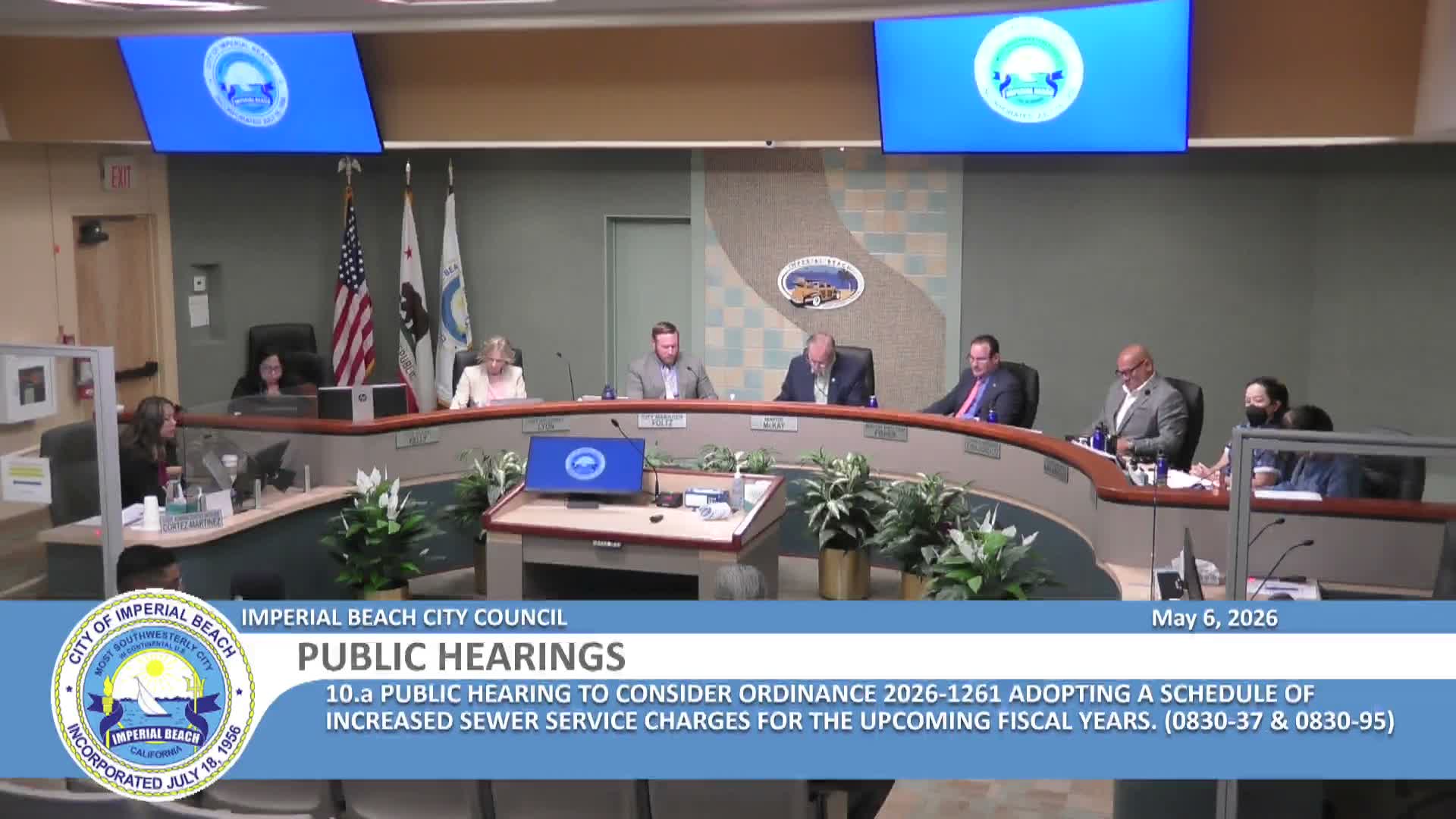
The Imperial Beach City Council on May 6 adopted Ordinance 2026-1262 to raise sewer service rates under the council’s Option 1 plan, a near‑term rate increase intended to restore reserves and fund pump‑station and lining capital projects; the vote carried unanimously by those present.
The Imperial Beach City Council voted unanimously May 6 to adopt Ordinance 2026‑1262, selecting Option 1 from a staff‑presented set of rate scenarios designed to bring the sewer fund closer to full cost recovery and finance planned capital improvements.
Staff and consultant Carmen Kasner told the council that the largest driver of higher wastewater bills is the City of San Diego’s metro treatment costs, not local operational increases. "The last item is the biggest driver, the metro costs," Kasner said while explaining the rate study and four proposed options. Kasner said revised 2027 metro charges the city received were lower than earlier projections but that costs for 2028–2029 remain uncertain.
Mayor Mitchell D. McKay moved to adopt Option 1—a plan that front‑loads increases over three years so the city can rebuild reserves and fund pump‑station rehabs and sewer lining. "It would be my motion to go with option 1," McKay said. The motion was seconded and the council voted to adopt the ordinance; the minutes record "motion carried unanimously" by those present.
Why it mattered: council members repeatedly emphasized the need for adequate reserves so the city can pay for multi‑year capital work and be prepared for emergencies or large repairs. Councilmember Seaberry and Mayor Pro Tem Fisher stressed that spreading costs over more years increases the risk the city will exhaust reserves and face higher long‑term costs; Fisher said he preferred addressing the shortfall now rather than deferring pain.
Key details and caveats: the public hearing was held under Proposition 218 notice requirements; staff noted the city must post annual notices if it opts to pass metro costs through (Option 4) and that Option 4 can create unpredictable single‑year charges. Public Works Director Juan Larios said the city currently has plans and near‑ready specifications for several sewer CIP projects, including pump station work and lining, but those projects require funding to proceed. Technical and legal true‑ups from the City of San Diego may alter final costs in future years.
Next steps and implementation: the ordinance (listed as Ordinance 2026‑1262 in the agenda documents) will be included as Exhibit A with the selected Option 1 rates. Staff will implement the rate schedule and complete associated Proposition 218 notifications and billing changes. The council discussion did not record a detailed member-by-member roll‑call tally in the oral vote; the final motion was recorded as carried unanimously by those present. Leila Gonzalez was noted absent for part of the hearing.