Get Full Government Meeting Transcripts, Videos, & Alerts Forever!
Get email alerts on the Teaching And Learning topic
No spam. Unsubscribe anytime.
Huntsville City Schools highlights report-card gains and pushes math, literacy and special-education supports
Summary
District leaders told the board Dec. 2 that Huntsville City Schools'report-card score rose to 88, outlined literacy and math strategies tied to the Achieve 2029 plan, and described hiring and programs to accelerate support for students needing interventions.
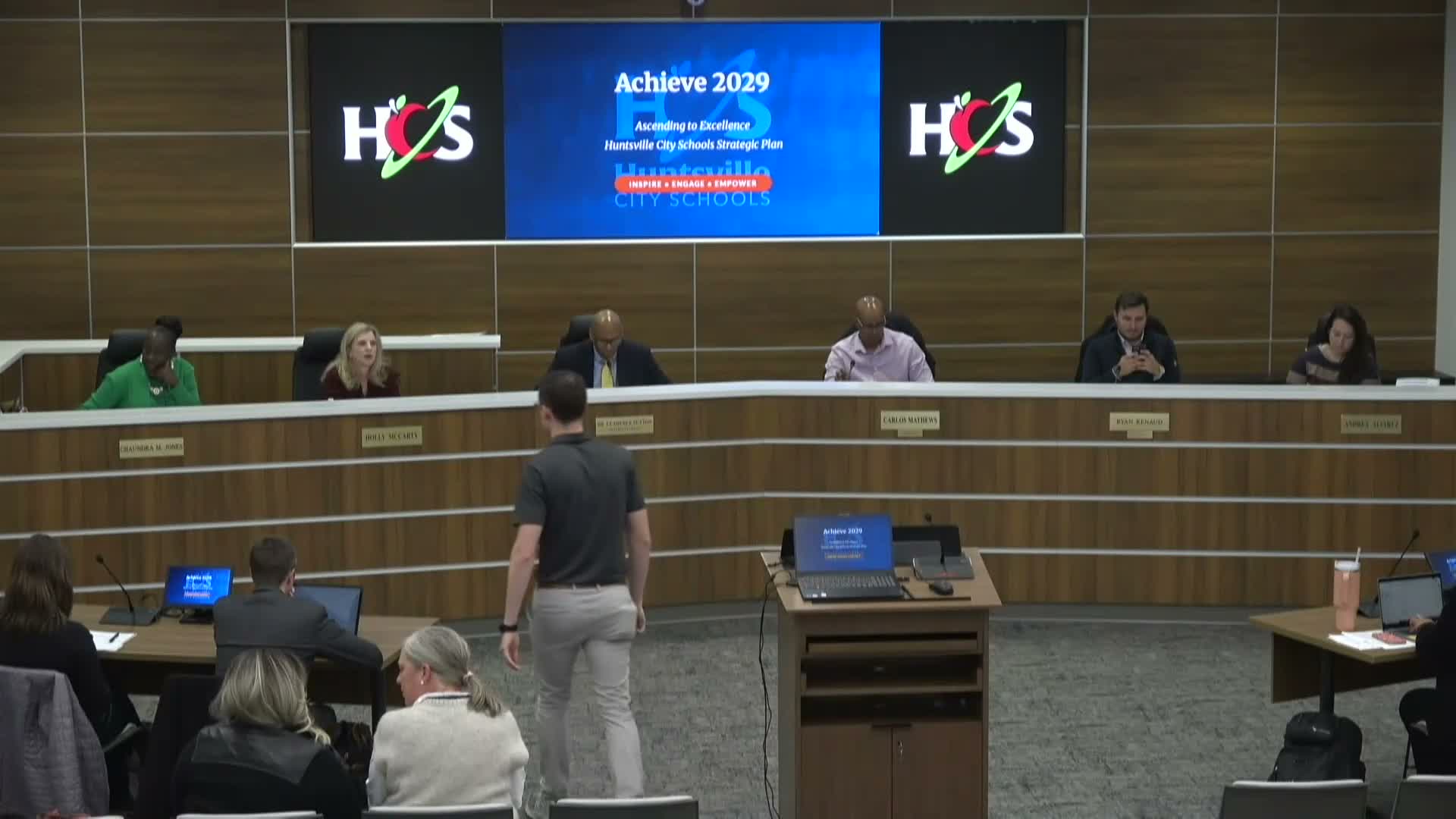
HUNTSVILLE, Ala. ' Huntsville City Schools presented a progress update Dec. 2 on its Achieve 2029 strategic plan, reporting a district report-card score of 88 and outlining targeted work in literacy, math and special education.
Deputy Superintendent AJ Buckner told the board the district's overall score rose from 85 to 88 and that leaders have set an internal two-point improvement goal for academic achievement. "We're super excited about that," Buckner said, calling out increases in graduation rate and college-and-career readiness as areas of measurable growth.
The presentation said 33 of the district's 43 schools improved overall; district staff highlighted Montview and Chapman Middle School among notable improvers and said 15 schools now earn an A grade. Buckner said schools scoring C or D will receive targeted improvement plans and additional support.
Larry Salisbury, director of K-12 literacy, described goals to raise reading proficiency from roughly 58% toward a district target of about 71% for grades 3'8 and detailed screening and intervention schedules using DIBELS and I-Ready. Salisbury said the district is expanding administrator and teacher cohorts for reading instruction and increasing dyslexia screening and early interventions in K'3.
Sheila Roby, director for STEM instruction, summarized five priorities to boost math outcomes: professional development for teachers and coaches, alignment of curriculum and resources to standards, standards-based lesson planning, data-driven instruction and teacher support. Roby said math coaches spend structured time in classrooms and that the district redesigned pacing guides this summer to improve lesson planning.
On special education, Buckner said the district has hired dozens of positions this year (including collaborative resource teachers and speech pathologists) and emphasized work to complete timely evaluations and to expand transitional and adaptive services. The presentation noted that just under one-third of students receive special-education services; district leaders said filling remaining open positions will accelerate evaluations and supports.
Board members asked about implementation and follow-through, including how principals and teachers are being held to consistent practices and how tools such as CERT and I-Ready are used in the classroom. Salisbury and Roby said the district is surveying schools to see which materials are used most effectively and is emphasizing coaching and PLCs (professional learning communities) to turn training into daily practice.
The board did not take action on the update; staff said work under Achieve 2029 will continue to be reported at future sessions.