Get Full Government Meeting Transcripts, Videos, & Alerts Forever!
Get email alerts on the School Budget topic
No spam. Unsubscribe anytime.
Bridgewater‑Raynham holds public hearing on proposed FY27 budget as committee warns towns may struggle to fund restorations
Summary
The Bridgewater‑Raynham school committee presented a proposed FY27 budget that would restore 10 classroom positions and raise district spending 4.92%; committee leaders said town revenue constraints and limited state aid could prevent full funding and urged continued local and state advocacy.
Rachel King, chair of the Bridgewater‑Raynham Regional School District school committee, opened a public hearing at 7:02 p.m. to present the committee’s proposed Fiscal Year 2027 budget and to solicit public comment. The committee said it will take the budget "under advisement" tonight and hold a formal vote by the full committee on March 25, 2026.
The budget presented calls for an overall operational increase of about 4.92%, driven by transportation contract increases, staffing contractual obligations, and an estimated 15% rise in health‑insurance costs. King said the subcommittee’s proposal focuses on the district’s four Student Success Plan pillars—safe and supportive schools; curriculum, instruction and assessment; operations; and human capital—and would restore 10 classroom teacher positions lost over prior years.
"We cannot make any more cuts," King said, outlining how restored positions would target K–8 class sizes and add staff at the high school to address lost electives and an accreditation warning. Superintendent Brian Powers expanded on that case, saying the district has been on a funding "roller coaster" and is down dozens of positions compared with previous years: "These are restoring 10 of the 72 positions that we've lost over the last two years," Powers said.
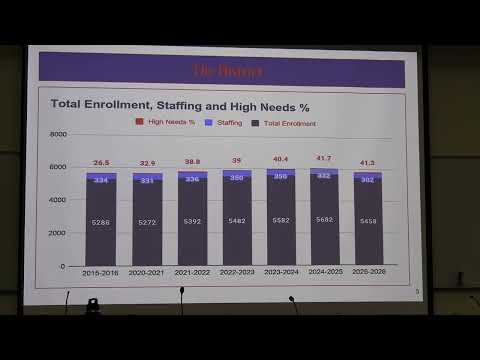
The committee highlighted enrollment declines—about 224 students lost in the last year—which reduce Chapter 70 aid and increase net assessments on the two member towns. King presented draft assessment figures the budget would create: a Bridgewater increase of roughly 9.87% and a Rainham increase of about 7.8%, reflecting the district’s regional allocation formula and shared student population.
Local and state funding limits were a central theme. Committee members noted towns’ preliminary signals that they may only be able to raise property revenue by about 2.5% (Bridgewater) and 1.52% (Rainham) without an override. Powers and members urged continued advocacy for steadier state funding. "If Chapter 70 had a consistent inflationary factor, we could plan better," Powers said.
During public comment, state Representative Dennis Galler said he was "disappointed" in the governor’s proposed Chapter 70 funding but expected the House to modestly increase school aid before final passage. Finance committee chair MJ Spagon urged closer coordination between town finance officials and the school committee earlier in the budget cycle. Parents, teachers and town council members described classroom strain, staff burnout and the impact of large class sizes; one parent said she had moved a child to private school because district options had narrowed.
The committee then voted to take the budget "under advisement." The motion, moved by Vice Chair Loch and seconded by Mr. Fitzgiven, carried on a voice vote with one dissenting vote from Mr. Guthro. The committee reiterated that final approval by the full school committee is scheduled for March 25, and that approved district budgets will move to the Bridgewater Town Council and the Rainham Town Meeting for their votes in May.
What happens next: the budget subcommittee will review feedback from tonight’s hearing at meetings scheduled before the March 25 vote; the full committee must secure a two‑thirds majority to adopt the FY27 budget that night. Community members were encouraged to follow town budget processes and forthcoming committee meetings.