Get Full Government Meeting Transcripts, Videos, & Alerts Forever!
Get email alerts on the Local Accountability topic
No spam. Unsubscribe anytime.
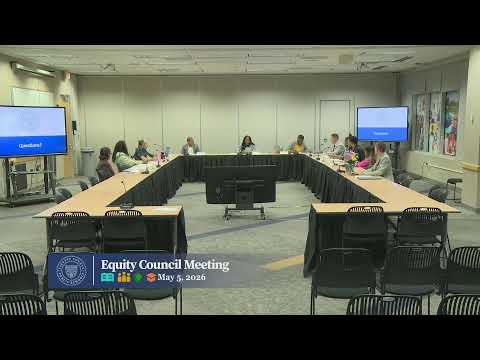
Fayette County Equity Council hears local accountability update under House Bill 257
Summary
Dr. Bill Bradford briefed the ECC on Fayette County’s draft local accountability model required by House Bill 257, describing locally developed indicators to sit alongside state measures and a pilot planned for 2026–27; members pressed for alignment with the equity scorecard and broader community input.
Dr. Bill Bradford, presenting for Fayette County Public Schools, updated the Equity Council Committee on the district’s work to build a local accountability model as directed by House Bill 257. He said the model will preserve state measures such as reading and math proficiency, graduation rates and transition readiness while adding locally developed indicators that reflect community priorities.
The presentation, based on more than 30 community input sessions and a guiding coalition of district and community members, emphasized ‘‘vibrant learning’’—real-world, project-based experiences tied to academic standards—and student agency, equity and career readiness. Bradford said the district plans a low-stakes pilot in 2026–27 with broader implementation and a public-facing display (a dashboard or similar) that will show locally developed indicators and, when possible, disaggregated subgroup data.
Committee members asked how the district’s equity scorecard relates to the local accountability model. Bradford said the equity scorecard currently ‘‘stands alone’’ as a consideration but that integration or complementarity is possible; he gave as an example a locally tracked expectation (e.g., minimum annual field trips) that might not appear on the equity scorecard but could appear on the local public display. Bradford also described translation and interpretation supports used during input sessions and acknowledged the need for more virtual and evening options to increase participation.
Why it matters: HB 257 requires districts to develop local accountability; Fayette County’s approach will determine which non‑test measures are publicly reported and how community priorities shape school evaluation. Committee members emphasized avoiding duplication with the equity scorecard and ensuring equitable access to input opportunities.
Asked about next steps, Bradford said a draft framework will be presented to the Board of Education at its June action meeting and that the district’s guiding coalition will continue refining indicators and piloting implementation through 2027–28.
The ECC’s discussion included repeated requests for clarity on community outreach methods, site selection for input sessions, language access and how equity measures will be incorporated. Bradford said more work is required to determine the degree of integration with the equity scorecard and offered to return with follow-up information.