Get Full Government Meeting Transcripts, Videos, & Alerts Forever!
Get email alerts on the Land Use topic
No spam. Unsubscribe anytime.
Port Orchard hearing reviews proposed R2-to-R3 rezoning for 2.7-acre Whole Avenue site
Summary
A Dec. 3 hearing before the Port Orchard hearing examiner considered a site-specific rezoning (LU25-reszone-01) that would change roughly 2.7 acres from R2 to R3 near Sherman Avenue and Melture Street West. Staff issued a neutral recommendation; residents raised safety, sidewalk, drainage and neighborhood-compatibility concerns. The examiner will send a recommendation to City Council.
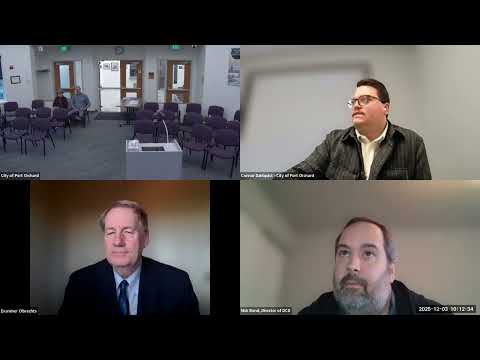
PORT ORCHARD, Wash. — The Port Orchard hearing examiner on Dec. 3 held a public hearing on a site-specific rezoning application, LU25-reszone-01, seeking to change about 2.7 acres at the Sherman Avenue / Melture Street West area from R2 to R3 zoning. No decision was made; the examiner will file a written recommendation to the City Council after reviewing the record.
Connor Dalquist, associate planner for the City of Port Orchard, said the application applies to the R2 portion of two tax parcels and that, if approved, it would allow multi-family development types not currently permitted on the site. "The department issues a neutral recommendation to the hearing examiner," Dalquist said, adding that staff found the proposal consistent with the city's comprehensive plan and the Port Orchard Municipal Code where applicable. He said the record includes 34 exhibits and that a Determination of Non-Significance (DNS) was issued Sept. 18, 2025 and later modified Oct. 29, 2025 to correct a public comment period error.
The applicant's representative, Larson, described the rezoning as an infill opportunity that would require frontage improvements and argued the change would not substantially change potential building scale. "If we were to build town homes we believe that we could build roughly 75 bedrooms versus around 100 bedrooms if they were apartments," Larson said, framing the request as expanding housing options and noting required street and sidewalk improvements would be addressed at the development-permit stage.
Residents who spoke urged denial or careful scrutiny. Lindsay Paradiso, a Hull Avenue resident, said the R3 designation would "introduce a scale and intensity that doesn't align with any surrounding parcel" and argued the parcel is not appropriate for medium-density zoning despite nearby apartment projects. Savannah Coats, who lives directly across the street from the site, pressed safety concerns: she said Whole Avenue has blind driveways and vehicles traveling at high speeds and argued there is no practicable way to extend continuous sidewalks to connect the site to nearby services and bus stops. "It's going to be very, very dangerous for these kids in their bus route," Coats said.
Longtime resident Miss Walstrom raised hydrology and vegetation concerns, saying removal of vegetation and adding impervious surfaces could increase cascading runoff on downhill properties and risk slope stability during heavy precipitation events. "It just doesn't seem like a safe level of development," she said, urging the examiner and staff to consider drainage and critical-area impacts.
Examiner (hearing officer) guidance and next steps were emphasized throughout the hearing. The examiner reminded attendees that, under state law, City Council is limited to a closed-record review and may not accept new evidence; therefore comments must be placed in the hearing record now if residents want them considered. "By state law, there's only one public hearing allowed per development project," the examiner told attendees.
City engineering staff described the immediate street conditions. Chris Hammer, assistant city engineer, said Whole Avenue currently has 9-foot lanes and no sidewalks in the subject segment and that a development generating more than 30 trips would require off-site improvements when a development application is submitted. Nick Bond, director in community development, noted that the city's 2024 comprehensive-plan update changed planning obligations by requiring capacity for housing at multiple income bands; he said that shortfalls in lower-income-band housing are a factor the city considers.
The hearing was closed at the end of the public comment period. The examiner said he expects to issue a written recommendation to the City Council within a couple of weeks; the council's decision would be by ordinance after a closed-record review. The planning/permit center will distribute the examiner's recommendation to interested parties on request.