Get Full Government Meeting Transcripts, Videos, & Alerts Forever!
Get email alerts on the Land Use topic
No spam. Unsubscribe anytime.
Port Orchard council affirms hearing examiner, approves site-specific rezone to allow apartment development
Summary
After a closed-record, quasi-judicial review of application LU25 (reszone-01), the Port Orchard City Council voted 5–2 to affirm the hearing examiner's recommendation and approve a rezoning from R2 to R3 for parcels on Hall Avenue, a change that allows apartment-style development and increases potential density.
The Port Orchard City Council voted 5—2 to affirm the hearing examiner's recommendation and approve a site-specific rezoning (LU25 reszone-01) for parcels on Hall Avenue, moving the properties from R2 to R3 zoning and enabling apartment building types that support higher unit density.
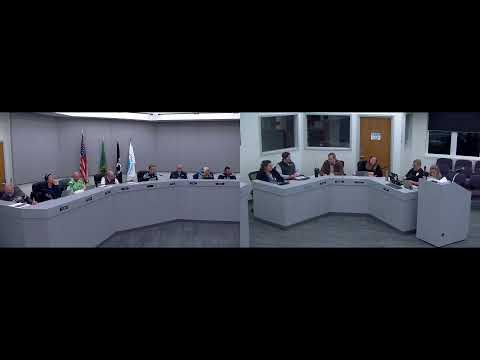
The hearing was conducted as a closed-record quasi-judicial proceeding. City Attorney Charlotte Archer reviewed appearance-of-fairness requirements and asked each council member to disclose contacts and conflicts; no council member announced a recusal. Staff presented a neutral summary of the record and noted the hearing examiner's finding that the proposal meets the criteria in Port Orchard Municipal Code 20.42.030 and reflects recent comprehensive-plan and state-law changes, including House Bill 1110.
Director Bond told the council that the R3 designation permits an apartment building type (rather than the smaller multiunit forms allowed in R2) and described outreach and notice (300-foot mailings and a legal notice). The applicant, Larson, reiterated arguments from the record that the site would act as a pedestrian connector to downtown, that infill apartment housing would represent a modest density increase consistent with the Growth Management Act and the city's comprehensive plan, and that frontage improvements would be required for any development.
Several residents who had testified at the original hearing reiterated opposition. Athena Walrram, a nearby resident, told the council the neighborhood's character and hazard concerns (stormwater, vegetation, slope stability) were raised in prior testimony and questioned whether the change-in-conditions test was met. Lindsay Paradiso said she circulated a petition submitted to the record and said neighbors are not opposed to housing in general but oppose apartments that do not fit local character. Savannah Coats, who lives adjacent to the site, said a sidewalk connection would require temporary use of her private property and described a blind curve where adding sidewalks or a bus stop would be unsafe: "the only way for them to put a sidewalk in is literally to put one on my property," she said.
Council members asked staff and the applicant about SEPA review, notification to the school district about potential bus stops, the application and ordinance dates, how many bedrooms could be built under R2 versus R3, and how the hearing examiner interpreted —3 changed conditions—4 criteria. Director Bond and the hearing examiner's decision in the record explained that the comprehensive plan update adopted in late 2024 and the larger Forest Song project in the area were treated as changed circumstances supporting the rezoning analysis.
After a closed deliberation under RCW 4230.1402, Council Member Diner moved — and Council Member Morsy seconded — a motion to affirm the hearing examiner's decision. The motion passed 5—2. Staff was directed to prepare written findings and a decision consistent with the council's motion.
The council's action affirms the record-based recommendation; it does not approve a specific development proposal. Future project-level review (including SEPA and any required off-site improvements such as safe school-bus access or sidewalk work) will be required when an actual development application is filed.
The council returned to regular business after the vote; staff will prepare and publish the written findings and final decision as directed by the council.