Get Full Government Meeting Transcripts, Videos, & Alerts Forever!
Get email alerts on the Carbon Removal topic
No spam. Unsubscribe anytime.
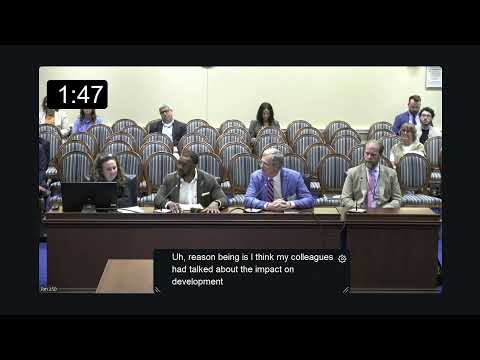
Committee hears carbon-removal bill; proponents tout "wood vaulting" and farming benefits
Summary
SB 625 directs the Maryland Department of the Environment to adopt rules for carbon capture, removal and sequestration projects; witnesses described wood burial ("wood vaulting"), biochar, and other techniques as scalable removal pathways and raised questions about permanence, regulatory classification, and property impacts.
Senate Bill 625 — the Carbon Dioxide Capture, Removal and Sequestration bill — was presented to the committee on April 2, 2026. The amended bill removes funding provisions and requires the Maryland Department of the Environment to adopt regulations for carbon removal projects by Jan. 1, 2028.
Fredricka Straus, representing Senator Brian Feldman, framed the revised bill as a narrow step to provide regulatory clarity for an emerging carbon-removal industry and to position Maryland to benefit economically and environmentally. Dr. Ning Zeng, testifying in support, said gigaton-scale carbon removal is now necessary to stabilize the climate and noted technologies developed at the University of Maryland. He estimated Maryland’s potential at roughly 1.2 gigaton-per-year equivalent in sequestration benefit, likening the impact to taking "300,000 cars off the road." He emphasized regulatory uncertainty as the major barrier to scaling these approaches.
Jamie DeMarco of the Chesapeake Climate Action Network described "wood vaulting" (burying woody biomass in engineered holes so that carbon is sequestered) as distinct from landfilling and urged MDE to treat properly engineered biomass burial as a regulated, permissible activity rather than a landfill. Mark Smith, CEO of Carbon Country, added detail about on-farm economics and biochar production, saying farmers could generate new revenue from otherwise low-value woody residues and that treated residues are considered "not waste" by EPA practice in some contexts.
Committee members asked practical questions about permanence, property records and land values. Delegate Anderson asked whether wood burial would appear on property deeds and whether subsequent owners could discover or be affected by buried carbon storage. Panelists said international standards require guarantees against excavation for climate accounting (durability expectations of 100–1,000 years) and that engineering practices preserve topsoil to limit surface productivity loss; they acknowledged some uncertainty about long-term productivity and emphasized regulatory safeguards.
Advocates emphasized co-benefits such as fire-risk reduction and rural economic opportunities; panelists and the sponsor urged rulemaking to enable safe, monitored projects. Questions and clarification focused on MDE’s regulatory scope, whether materials would be classified as waste or assets, and how permanence and monitoring would be enforced in practice.
The committee concluded the hearing after extended technical discussion; proponents urged a favorable report to provide regulatory clarity and to enable pilot projects and private investment, while some legislators sought more detail on long-term safeguards and deed/land-value implications before advancing rulemaking.