Get Full Government Meeting Transcripts, Videos, & Alerts Forever!
Get email alerts on the Flood Management topic
No spam. Unsubscribe anytime.
Debate over interjurisdictional flood-management bill pits flood-resilience advocates against housing and development groups
Summary
Lawmakers heard opposing testimony on SB 225, which would designate specified watersheds as interjurisdictional flood-hazard areas to improve coordinated planning; proponents said it fills permitting gaps and protects downstream communities, while opponents warned the bill is vague and could delay or halt affordable housing and other development.
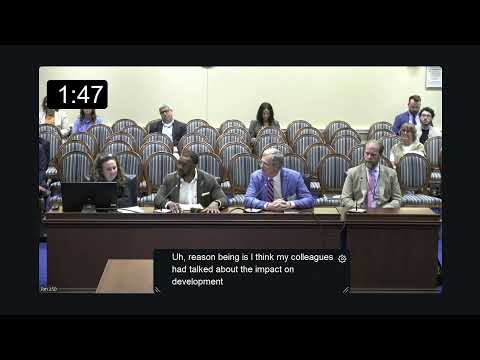
The House Environment and Transportation Committee on April 2, 2026 heard extensive testimony on Senate Bill 225, a measure to designate several watersheds as interjurisdictional flood hazard watersheds and require coordinated flood-management planning across local jurisdictions and the Maryland Department of the Environment.
Supporters told the committee the measure aims to close planning gaps that allow upstream development to increase downstream flooding. Winnie Carpenter, representing Oella Catonsville Flood Solutions, urged a favorable report and asked the committee to include the Patapsco River, saying fragmented permitting and funding between neighboring counties leaves downstream communities exposed. Christiane Marguerite, a resident of Southeast Baltimore City, said runoff from upstream development in Baltimore County is already increasing flooding and pollution in her neighborhood and urged stronger, holistic coordination.
Opponents—ranging from Baltimore County officials to affordable-housing developers—said the bill is ambiguous and risks imposing new, unclear review steps that would delay projects. Horacio Tablada, director of Baltimore County’s Department of Environmental Protection and Sustainability, told the panel the bill would "bypass what MDE is already doing" with technical watershed studies (the Advanced Stormwater Resiliency work group) and could prioritize the named watersheds without regard to statewide data-driven needs. Developer and nonprofit witnesses—including Andrew Hanson (Homes for America), Emily Hovermale (Baltimore Regional Housing Partnership), and others—said the uncertain standards and overlapping authority could put committed financing at risk and add months or more to entitlement timelines for affordable-housing projects.
Several opponents directly linked the bill to an ongoing dispute over a proposed affordable-housing project in Towson, arguing the legislation could be used to stop or slow that specific development. Andrew Hanson said engineers and reviewers do not see a clear regulatory purpose in the text and warned the bill "creates hurdles for numerous important and much-needed affordable housing" projects. Proponents denied the bill's intent is to block a particular site and framed it instead as a tool to foster coordination so that upstream decisions account for cumulative watershed impacts.
Committee members pressed on several technical points: why only the listed watersheds, how interjurisdictional plans would interact with existing MDE authorities and local planning processes, and whether the bill would require new studies or pause development pending joint approvals. Spoken concerns included the potential fiscal impact on local governments to prepare new plans and the legal uncertainty about what triggers additional review. Witnesses noted differing local experiences—some stressed immediate harms from upstream tree removal and permitting that lacked clear public notice; others cited Maryland’s already stringent watershed rules and ongoing regulatory work that, they said, should proceed through stakeholder processes.
The committee did not take a vote at the hearing’s close. The record shows robust division between advocates seeking stronger watershed oversight and stakeholders warning of regulatory ambiguity and housing-supply consequences. The Committee concluded the hearing without adopting amendments on the floor; further action or votes were not recorded during the session.