Get Full Government Meeting Transcripts, Videos, & Alerts Forever!
Get email alerts on the School Funding Referendum topic
No spam. Unsubscribe anytime.
Siren School District lays out $1.8 million operating referendum, warns of staff and program cuts if it fails
Summary
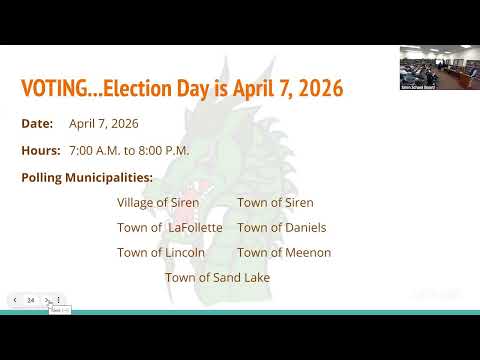
At a public forum, Siren School District officials read the April 7 ballot question asking voters to allow $1.8 million per year for three years and outlined potential reductions—including cuts to interventionists, counselors, music, and other positions—if the measure fails. Officials said the district entered a negative fund balance and used short‑term borrowing to cover cash needs.
Moderator read the referendum language to attendees: “Shall the school district of Siren, Burnett County, Wisconsin be authorized to exceed the revenue limit specified in section 121.91 Wisconsin Statutes by $1.8 million per year for 3 years beginning with the 2026–2027 school year and ending in the 2028–2029 school year for non‑recurring purposes consisting of operational expense including to maintain educational and elective programming at Siren schools,” and said the district would answer questions and post follow‑up FAQs.
The district presented the financial case for the referendum, saying the request would raise roughly $1.8 million per year for three years and would equal about $10.25 per month (about $123 per year) on a $100,000 property. Presenters said the levy would add approximately 1.23 mills to the current 5.83‑mill levy and displayed scenarios comparing cuts, no cuts, and the referendum with reductions.
Officials described how state aid and the revenue limit formula affect Siren: a three‑year rolling average of enrollment and rising local property values alter aid calculations. Presenters noted Siren’s property values increased about 16% in the most recent data versus a state average near 8%, which can reduce aid. They also said the district faces high poverty and a substantial special‑needs population, both of which increase service costs.
Board and staff walked through specific positions that could be reduced if the referendum fails or if revenues remain constrained. Among the items detailed: reducing elementary physical education from full‑time to half‑time; cutting one of two interventionists (leaving a single interventionist to cover tier‑two and tier‑three reading supports); reducing the Native American home/school coordinator position from full time to half time; combining two counselors into one district‑wide counselor; reducing band and choir staffing from two positions to one; and potential administrative furloughs, reassignments or shared teaching duties. Presenters stressed that losing the school psychologist (currently an 85% position) or an interventionist would materially affect services for struggling and special‑needs students.
Officials said the district resorted to short‑term borrowing to meet cash‑flow needs and that the most recent year‑end fund balance was negative (reported at about $294,000). A district financial consultant (Baird) advised a loan followed by a referendum to restore solvency; district staff said that with the referendum and prudent reductions the district could approach a typical 15–20% fund‑balance target and avoid short‑term borrowing in future years.
Several residents asked how the new levy would interact with an expiring $400,000 referendum; presenters confirmed the expiring levy drops off if replaced by a new referendum, so a homeowner’s net change depends on property valuation and the existing levies. Presenters also promised to publish a line‑by‑line FAQ, including a breakdown of how COVID federal relief funds were used and which items were restricted by federal guidance.
Attendees questioned whether cuts would reduce academic quality or opportunities for college‑bound students. District staff said course catalogs and remote/partner options (including college credit offerings and regional co‑ops) remain available but noted that low enrollment in some advanced classes has made in‑house offerings difficult. They said board decisions later will determine which previously implemented reductions, if any, would be restored should the referendum pass.
Speakers also discussed broader remedies and contingencies: shared‑staff or whole‑grade‑sharing agreements with neighboring districts, cooperative arrangements for some positions, and longer‑term strategic planning that would run whether the referendum passes. They emphasized the three‑year measure was intended as a window to stabilize finances, attract and retain teachers, and pursue partnerships rather than a permanent one‑time patch.
The forum closed with a board speaker urging community deliberation on the referendum and offering contact information for follow‑up questions and the district FAQ page. Staff corrected one enrollment calculation before adjourning and reiterated they would post additional budget detail online.