Get Full Government Meeting Transcripts, Videos, & Alerts Forever!
Get email alerts on the School Infrastructure Referendum topic
No spam. Unsubscribe anytime.
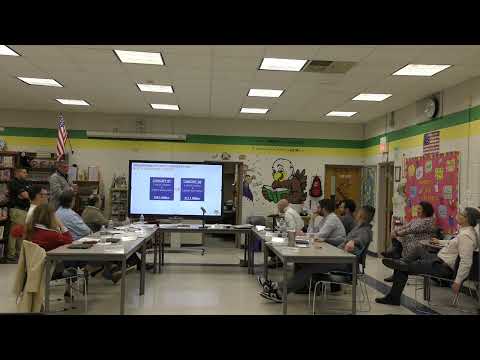
Architects outline two referendum options; board discussion, public comment lean toward larger plan adding second music room
Summary
Architects presented two mid-range referendum concepts to the Boonton Township School District board: B1 (about $10.1M educational cost) and B2 (about $11.9M, adds a second music room). Board members and public commenters largely favored B2 for program quality and safety; the district will submit an application to the New Jersey Department of Education and expect state subsidy estimates in a few months.
Architects and district leaders presented two referendum concepts to the Boonton Township School District board on facilities and educational-space upgrades, and board discussion at the end of the meeting showed a drift toward the larger option that adds a second, dedicated choral room.
Greg Samjen, one of the presenting architects, summarized the district’s needs and history and said the educational additions were intended to restore former storage areas to proper classrooms, end multiple teachers sharing windowless spaces and provide correctly sized specialized rooms for music and STEM. “This proposal is approximately $10.1 million,” Samjen said when describing Concept B1, and he described Concept B2 as a larger option that comes in at about $11.9 million by adding a second, properly sized choral room.
The package under discussion pairs the chosen educational concept with infrastructure projects the board has already advanced. Samjen said the infrastructure work is roughly $16.6 million (the board expects some debt-service aid) and that the combined referendum totals would be about $26.7 million if the board chooses the smaller educational option (B1) and about $28.57 million if it elects B2. He told the board the district will submit its application to the New Jersey Department of Education and that a preliminary eligible cost letter from the state will determine the actual subsidy and allow the district’s financial adviser to calculate household tax impacts.
District leadership and architects explained the principal drivers of difference between B1 and B2. The addition that creates a second music room is roughly a 1,200-net-square-foot space; that extra area plus proportional increases in hard costs, contingency, market-escalation assumptions and soft costs produced an approximate $1.8 million price gap between the two concepts. Samjen also noted that interior renovations may receive a partial state subsidy while exterior additions generally do not; for interior work the presenters said the state subsidy is expected to be about 34 cents on the dollar but that the exact amount will be confirmed by the Department of Education letter.
Superintendent Ken Fertini addressed enrollment and demographic concerns and confirmed that the district completed a demographic study in 2022 and has authorized an update; “Our last demographic study…we did one in 2022,” Fertini said, noting such studies are generally valid for about five years and that an update is in progress. Architects and staff explained that the planned additions are intended primarily to correct overcrowding and shared-space issues rather than to anticipate an immediate, large influx of new students, and they said a hypothetical increase (for example, 100 students) could be absorbed by the proposed layout.
Board members pressed the team on scheduling and program needs for music instruction: band and chorus currently juggle space, sometimes using the gym for full-band practices and moving instruments daily. Board members and presenters said properly sized rooms with higher ceilings and acoustical treatments would reduce equipment wear, improve instructional time and address safety concerns tied to cramped practice areas.
Several board members said they initially leaned toward the smaller, more-cost-conscious option but changed their view after discussion of program disruption, safety and the prospect of rising construction costs. One board member framed the tradeoff as a long-term question about whether to bond the modest additional amount over a multi-decade schedule to secure better facilities now.
Public commenters present during the meeting voiced support for investing in the school after a long delay in capital work and urged clear communication about tax impacts. One commenter suggested exploring a sending/receiving relationship with a neighboring district as an alternative way to manage space, but participants said that would be a major policy decision outside the scope of the current facilities application.
No formal referendum question was adopted at the meeting. Samjen said the infrastructure application has already started and that the board is targeting May 1 for the educational application submission; he said the state’s preliminary subsidy letter should follow in roughly two to three months, after which the financial adviser will provide voter-facing tax-impact estimates.
What’s next: the board must choose an educational concept to finalize the application. After submission, the district expects the Department of Education’s eligible-cost letter to arrive within months and the board will then decide whether to place the combined infrastructure and educational package before voters.