Get Full Government Meeting Transcripts, Videos, & Alerts Forever!
Get email alerts on the Forensic Technology topic
No spam. Unsubscribe anytime.
FBI outlines plan to bring rapid DNA profiling into booking stations, but legal, technical and funding hurdles remain
Summary
FBI official Tom Callahan described a multi-step plan to enable —rapid DNA' profiling in booking stations——swab-in, profile-out' processing, an electronic portal and immediate searches of a —rapidly enabled' index—while stressing the approach requires instrument approval, state system changes and possibly a federal-law change.
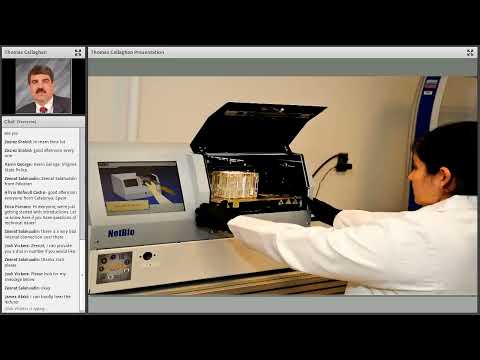
Tom Callahan, manager of the FBI's Rapid DNA program office, presented the agency's concept for deploying rapid DNA profiling in booking stations during a webinar hosted by RTI and the American Society of Crime Lab Directors (ASCLAD). Callahan described rapid DNA as a —swab-in, profile-out— process and said the FBI intends to deliver software and architectural support while states would be responsible for purchasing and validating instruments and providing necessary identity data.
Callahan emphasized a central legal constraint: current federal law requires that DNA profiles entered into the national DNA database be developed in an accredited laboratory. —This really is a concept and without a change in federal law to allow DNA profiles to be entered into the national database from outside an accredited laboratory, this remains a concept,— he said. The FBI's plan therefore emphasizes incremental preparatory steps that can proceed without a statutory change.
The rollout Callahan outlined is incremental. Early steps target better integration of booking workflows: place a DNA indicator on criminal-history records to avoid duplicate collections; move away from ink fingerprint kits toward live-scan capture; and eliminate paper submission forms by encoding biographic and booking data in barcodes linked to samples. Those preparatory steps, he said, would reduce delays and duplication even before rapid DNA instruments are approved for direct database submission.
If instruments are approved, the FBI would provide a CODIS-format portal (described in the talk as the —CODIS Rapid DNA portal—) to validate profiles, verify required metadata (state ID/UCN, ORI, instrument serial/model and operator), and enroll profiles. Callahan explained the portal would enforce quality rules before a profile could be submitted and would search a —rapidly enabled— portion of the national index (profiles from unsolved homicides or rapes, for example) for high-stringency, 13-locus matches.
On a confirmed match, the system would send an unsolicited notification to the booking station and the investigating agency; it would also notify the laboratory that originally developed the crime-scene profile so that laboratory acts as a —safety net.— Callahan said this parallel notification aims to reduce the risk of operational error when rapid notifications move outside the laboratory context.
Callahan outlined prototype software already under test that performs validation, enrollment and a hit/no-hit workflow. He said many architectural pieces already exist (live-scan/APB/NGI networks and message formats such as EBTS), but that the portal and related messaging systems still require development and policy work to support real-time or daily searches.
Cost and implementation questions drew sustained attention in the webinar's Q&A. Callahan said the FBI plans to provide the portal and conceptual architecture, but states and local agencies would be responsible for acquiring instruments, validating them and connecting them into state systems. He gave example numbers to illustrate current costs: a swab run that processes five samples can cost about $300, and the community would look for per-sample costs to fall into the $50—$100 range before broad adoption is likely in high-volume booking locations. Callahan did not identify specific funding sources and said arrangements would have to be resolved by agencies and funding partners.
Asked about safeguards against identity fraud (for example, someone using another person's name), Callahan said the booking-station process would be anchored to fingerprint-based identity: a state-assigned SID/UCN established by live-scan fingerprinting would be required before a swab was processed, making names or aliases secondary to biometric identity. He also noted that NGI/APB systems are audited and that the booking-station workflow would need tight coupling to those identity checks.
Callahan declined to give a firm national timeline, saying a national service depends on instrument approval and potential federal-law changes. He recommended that jurisdictions in states that already collect DNA from arrestees begin technical preparations now (SID management, duplicate-collection prevention and moving toward inkless, paperless processing) so they are ready if policy and approvals move forward.
The webinar and prototype demonstrations, Callahan said, illustrate the potential to accelerate investigative leads by enrolling profiles electronically from booking stations, but realize that major policy, technical and funding decisions remain ahead. The webinar was archived for later reference and the FBI planned follow-up documentation and interface-specification guidance for the rapid-DNA community.