Get Full Government Meeting Transcripts, Videos, & Alerts Forever!
Get email alerts on the Traffic Calming topic
No spam. Unsubscribe anytime.
NDOT consultant outlines Porter Road speed‑cushion plan; neighbors question collector status, diversion and ballot rules
Summary
NDOT consultant Jeff Hammond presented a preliminary speed‑cushion plan for Porter Road—about four cushion locations across a half‑mile—citing an 85th‑percentile speed of 37 mph and roughly 4,500 vehicles per day; residents urged attention to school safety, neighborhood character, diversion risk and the owner‑ballot process.
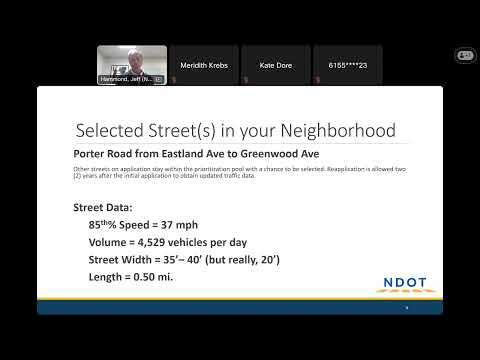
Jeff Hammond, a consultant for the Nashville Department of Transportation (NDOT), presented a preliminary traffic‑calming concept for Porter Road and asked neighbors for feedback at a virtual neighborhood meeting. Hammond said NDOT collected speed and volume data that showed an 85th‑percentile speed of 37 mph (meaning about 15% of measured vehicles exceeded that speed) and a daily traffic volume of roughly 4,500 vehicles, putting Porter Road close to NDOT’s 5,000‑vehicle threshold for typical speed‑cushion treatments.
Hammond described the proposal as a half‑mile project from Eastland to Greenwood (about 2,500 feet) with four sets of speed cushions spaced roughly 400–600 feet apart (an average spacing NDOT staff said is about 500 feet). He explained speed cushions are modular recycled‑rubber devices (typically six feet wide and about 10½ feet long) designed with gaps so large‑wheelbase emergency vehicles are less affected, and said cushions in practice have reduced measured speeds by about 9–11 mph in NDOT before‑and‑after data. Hammond also reviewed alternatives — speed tables, radar feedback signs, pavement‑marking treatments, bulb‑outs, chicanes, pinch points and traffic circles — and said the appropriate tool depends on volume, grade, driveways and neighborhood context.
Residents voiced mixed reactions. Meredith Krebs said she views Porter Road as a collector, citing the Metro major and collector street plan, and questioned whether speed cushions — a treatment NDOT has historically used more on local streets — are appropriate on a collector. "I think of this road as not a local street and I think the metro major and collector street plan represents it as a collector street," Krebs said, adding that the classification affects expectations for access and vehicle priority.
Kate Door, who identified herself as a resident, said she lives next to a nearby school (transcript: "Monasuri school") and that children’s safety and pedestrian comfort make traffic calming important. "I live right next door to the Monasuri school and with so many children coming and going the speeds really concern me," Door said, and she expressed support for traffic calming while questioning whether cushions are the right tool.
Other neighbors raised two recurring concerns: that cushions could divert traffic to adjacent local streets and that NDOT’s program lacks an iterative trial‑and‑adjust process. Hammond acknowledged diversion can occur — NDOT data show examples where roughly 20% of traffic diverted in dense grid neighborhoods — and said the agency generally cannot implement short‑term trial changes or routinely rework installed treatments because of demand (NDOT advances about 50 projects per year from a backlog of roughly 700 requests). He said NDOT aims to get designs right on the front end and will respond if a clear problem emerges after installation, but neighborhoods would effectively need to reapply and compete again for program resources if they want a different treatment later.
Hammond outlined the next steps: NDOT will prepare detailed design plans and may hold a second neighborhood meeting; for vertical treatments that require property‑owner approval, NDOT sends a postcard ballot to owners of record and holds a six‑week vote. If two‑thirds of property owners who receive ballots vote yes, the project advances to the construction queue. Hammond said ballots are sent to owners listed in assessor records (renters do not receive ballots) and that multiunit properties controlled by a single owner receive one ballot. He estimated that, even in an accelerated scenario, it is likely about a year from the design stage before installation occurs because of construction backlog.
Next steps for neighbors include providing feedback via NDOT’s traffic‑calming email and Engage Nashville, coordinating outreach to increase owner participation in the ballot, and deciding whether to request another neighborhood meeting or proceed toward design and balloting. The recording and project materials will be posted on NDOT’s traffic‑calming web page.
Ending: NDOT will accept written feedback and can return for another meeting if residents request it; any vertical treatment would still require the owner‑ballot and two‑thirds approval before construction is scheduled.