Get Full Government Meeting Transcripts, Videos, & Alerts Forever!
Get email alerts on the Transmission Project topic
No spam. Unsubscribe anytime.
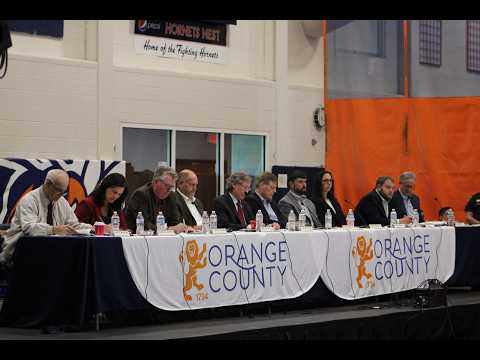
Orange County meeting draws strong opposition to Dominion/Valley Link 765 kV plan; board vows further action
Summary
Dominion Energy and its Valley Link joint venture presented a proposed 765 kV Joshua Falls–Yeet transmission line; county officials and more than 80 public commenters raised objections — citing greenfield routing through Orange County, property-value losses, health and environmental concerns — and the board signaled it will press for answers and next steps.
Dominion Energy and its Valley Link joint venture told the Orange County Board of Supervisors on March 24 that a proposed 115‑mile, 765 kilovolt transmission line between Joshua Falls and Yeet is intended to reinforce the Mid‑Atlantic grid and meet rapidly rising demand, particularly driven by data centers. Dominion representatives said the backbone line would be built largely on new right‑of‑way, include lattice steel towers about 135–160 feet tall and a typical corridor about 200 feet wide, and is scheduled for a state filing in September with an in‑service target of 2029 if approved.
The presentation, led by Brandon Stites (Dominion vice president of engineering and construction) and Adam Magcguire (Valley Link lead project manager), laid out the technical justification — including a stated capacity of roughly 6.6 gigawatts — and the routing process: an initial mapping phase, community open houses (March and June), route refinement, and then an application to the Virginia State Corporation Commission (SEC). Dominion said PJM, the regional grid operator, identified the need during its 2024 planning cycle and that the SEC handles final siting decisions.
Why it matters: county officials and residents said Orange County would bear most of the project’s local impacts while seeing little or no direct benefit. Supervisors and planning commissioners pressed Dominion on alternatives — including parallel use of existing rights‑of‑way, underground HVDC options and siting generation closer to Northern Virginia — and on the decision to move the Yeet substation location, which Dominion said reduced local impacts while preserving electrical outcomes.
Public outcry and themes from commenters More than 86 speakers signed up for the county’s public comment period and expressed near‑unanimous opposition. Common themes included:
- Property and economic harm: multiple residents said proposed routes would cut through farms and residential parcels, rendering land unusable for planned homes or agriculture and sharply reducing market value. One presenter said a realtor estimated an immediate $100,000 loss in home price on affected properties; others cited countywide impacts to land markets.
- Health and schools: several commenters, including the chair of the Orange County School Board, said routes come within a few hundred to 1,300 feet of schools and expressed concern about long‑term exposure to electromagnetic fields (EMF). Dominion cited World Health Organization and EPA guidance and said major agencies have not established a causal link between EMF and cancer, but residents and some commenters pressed for more independent study.
- Environmental, historic and water impacts: residents and local preservation advocates described threatened Civil War‑era battlefield areas, unregistered grave sites, forest fragmentation, impacts to wildlife and potential effects on private wells and local aquifers.
- Process and transparency: multiple speakers said route maps and online tools were incomplete or hard to use, described survey helicopters and limited notice, and urged the county to insist Dominion supply more detailed route data before an SEC filing.
Dominion responses and technical limits Dominion representatives repeatedly framed the project as a regional reliability need driven by growth in eastern PJM and by large commercial customers. They said:
- The 765 kV solution is an AC backbone meant to move large amounts of power from western PJM generation to eastern load centers; HVDC undergrounding is point‑to‑point and would require converter stations and much higher per‑mile costs to match the capacity Dominion proposes.
- In Orange County specifically, detailed routing showed little scope to parallel existing transmission corridors because many rights‑of‑way are already ‘subscribed’ (occupied by existing structures and nearby homes); Dominion said much of the corridor through Orange would be greenfield for those reasons.
- The company expects to file with the SEC in September and estimated the SEC process could take about a year; Dominion said it would provide notifications and make route updates public via its website and mailers.
Board actions and next steps Before the presentation the board adopted its agenda and consent items unanimously. After listening to residents, the Board of Supervisors and Planning Commission members publicly committed to follow up: the board said it will review written answers Dominion provided to an earlier list of 28 questions, prepare additional questions, coordinate with neighboring counties, and consider formal action in advance of the SEC filing. Chair Brian Nickel said the board has a consensus to engage and that the current routing through Orange County, described by multiple Dominion representatives as predominantly greenfield, presents “significant issues and impacts some of which are irreparable for generations to come.”
What remains unresolved Dominion and Valley Link left the meeting without a final route; the company plans further route refinements based on comments and another round of open houses in June. Key unresolved items residents and county officials said they want addressed before any SEC filing include more complete and up‑to‑date route maps, independent assessments of alternatives (including burial/HVDC and local generation options), answers about timing and material supply risks for an aggressive schedule, and explicit plans to avoid documented historic and environmental resources.
The board said it will pursue coordinated county responses, seek additional technical detail and legal options, and work with residents to evaluate intervention at the SEC when the case is filed. The planning commission adjourned; the board adjourned after voting to continue follow‑up and engagement.