Get Full Government Meeting Transcripts, Videos, & Alerts Forever!
Get email alerts on the Budget topic
No spam. Unsubscribe anytime.
Hollis/Brookline voters approve operating budget and several district funding items; SAU budget fails
Summary
Voters adopted the Hollis/Brookline Cooperative School District operating budget and approved trust and contract measures while the SAU-level appropriation and several tax-cap petitions failed. The meeting included extended debate over rules, open enrollment, and SB2.
Hollis/Brookline Cooperative School District voters on the annual 2026 meeting approved the district's operating budget and a set of related measures but rejected the SAU appropriation and several petitioned tax-limit proposals.
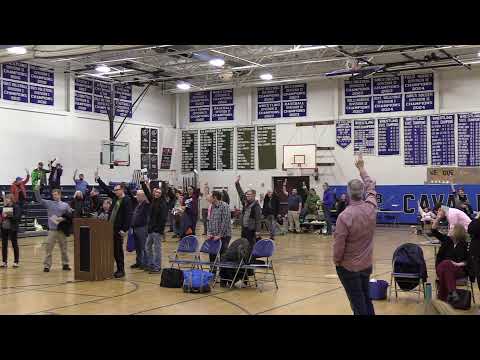
The assembly adopted the operating budget for fiscal year 2026-27 at $31,716,292 after budget committee and administration presentations that highlighted major cost drivers including rising bond debt, a 15.1% increase in health insurance costs and negotiated salary adjustments. The operating-budget article passed by voice count, 221 in favor and 212 opposed.
In votes that followed, voters approved: the second-year cost items in the three-year support-staff contract (Article 3, estimated additional cost $131,512), a facilities maintenance expendable trust (Article 4, up to $300,000 from the unassigned fund balance for roofing, track resurfacing and duct work), and a contingency fund (Article 5, up to $125,000). The school board and budget committee had recommended these articles with varying levels of support during the presentation and public debate.
The SAU budget (Article 1), which was decided by secret ballot of the combined SAU voting membership, did not carry. The moderator reported the combined totals across the three districts: 895 yes and 1,026 no, meaning the appropriation failed in the combined SAU tally.
Moderators and administrators emphasized that fixed costs, enrollment shifts and state aid changes affect tax effort and rates. Superintendent Gina Bergkar and board members highlighted recent capital projects (boiler conversion, ventilation upgrades, solar installation) and said the district will post performance and fiscal data on a new dashboard. Board member Tom Solon cautioned that state proficiency scores are distorted by opt-out rates and urged voters to consider additional measures of performance.
Several voters urged restraint on spending. Resident Eric Power urged a no vote on some items during debate, saying the SAU budget had grown quickly over the last decade and questioning certain line-item treatments. Others who supported the budget argued the administration had held proposals below guidance and that the district must plan conservatively for potential contingencies.
Votes at a glance: - Article 1 (SAU budget, secret ballot of SAU voters): combined totals reported 895 yes, 1,026 no (failed). (See transcript totals announced by the moderator.) - Article 2 (Operating budget): Passed, yes 221, no 212. - Article 3 (Support staff contract, year-two costs $131,512): Passed by voice vote. - Article 4 (Facilities maintenance expendable trust, up to $300,000 from unassigned fund balance): Passed by voice vote. - Article 5 (Contingency fund, up to $125,000 from unassigned fund balance): Passed by voice vote.
What happens next: The successful warrant articles will be implemented according to the district's financial schedule (for example, trust fund expenditures require subsequent school-board action and public hearings per the trust article). The SAU appropriation will not be implemented as presented because the combined ballot across the SAU failed.
Reporting notes: vote tallies and procedural rulings are recorded in the meeting transcript; in a few cases (voice votes) the moderator summarized the result rather than announcing per-person tallies.