Get Full Government Meeting Transcripts, Videos, & Alerts Forever!
Get email alerts on the Land Management topic
No spam. Unsubscribe anytime.
DNR regional director tells Hubbard County board the agency will seek earlier coordination on acquisitions, while defending recreation management
Summary
Minnesota DNR regional director Ben Bergie and staff briefed Hubbard County commissioners on the agency's 98,000-acre local portfolio, explained how DNR evaluates land acquisitions and said the agency will improve early coordination with counties; commissioners pushed back about lost tax revenue and access maintenance.
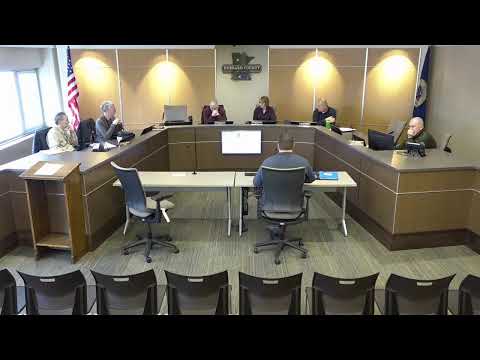
Ben Bergie, regional director for the Minnesota Department of Natural Resources, told the Hubbard County Board during a work session that DNR manages roughly 98,000 acres in the county—about 15% of local land—and that the agency aims to balance conservation, outdoor recreation and local economic interests.
Bergie introduced a team of local DNR staff and described agency priorities and recent work, including collaborations on land acquisitions, stocking lakes and work at Itasca State Park. He said DNR wants “to be a really good partner” and acknowledged the agency has not always engaged counties early enough on land acquisitions and other decisions.
Commissioners raised several concerns during a lengthy question-and-answer period. They asked how DNR selects lakes for walleye and muskie stocking; fisheries supervisor Carl Peterson said DNR targets lakes that can biologically support the stocked species rather than attempting to stock every lake. On public-water access maintenance, DNR staff said the state’s “Get Out More” capital initiative directed significant funding toward public-water-access improvements and that DNR staff will follow up with a list of accesses planned for investment in Hubbard County.
On land acquisition, commissioners criticized past purchases they said reduced the local tax base; a commissioner referenced a recent 431-acre acquisition and asked about lost tax revenue. Bergie said DNR evaluates parcels for conservation value and will strive for earlier, more transparent coordination so local governments have input before acquisitions are finalized. He acknowledged tradeoffs between conservation aims and county tax needs, saying, “we don't always hit that mark. I fully acknowledge that.”
Other topics discussed included off-highway vehicle and snowmobile event management (Bergie said DNR has formed a working group to consider protocols for competitive events on public lands), rules around conditional-use permits and shoreland classifications (Nathan Kesner said DNR generally defers to local zoning but will step in when permit variances or regulatory triggers arise), and management plans for a newly acquired wildlife management area (Eric Thorson described planned trail maintenance, parking and hunting access; dispersed camping would require a special permit and is not allowed by default).
Bergie and his staff committed to follow up on multiple requests from the board — including which Hubbard County accesses will receive Get Out More funds, numbers of conservation officers covering the county, and more detail on specific parcels and SNA (scientific and natural area) designations. The meeting closed with an agreement to improve early coordination with the county on upcoming DNR actions and acquisitions.