Get Full Government Meeting Transcripts, Videos, & Alerts Forever!
Get email alerts on the Alternative Practice Structures topic
No spam. Unsubscribe anytime.
CBA committee approves comment letter urging AICPA to explain private‑equity approach to alternative practice structures
Summary
The California Board of Accountancy’s Committee on Professional Conduct voted to approve a staff‑draft comment letter asking the AICPA to clarify whether and why private‑equity ownership of attest firms should be permissible and to address enforceability and appearance of independence concerns.
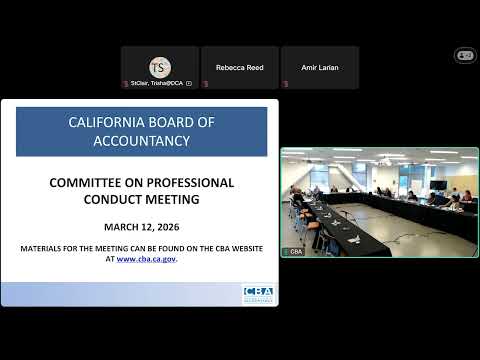
The California Board of Accountancy’s Committee on Professional Conduct voted March 12 to approve a comment letter to the American Institute of Certified Public Accountants on proposed revisions addressing alternative practice structures and private‑equity investment in CPA firms.
The committee approved staff’s recommendation to ask the AICPA to provide an upfront analysis explaining why APS ownership would be appropriate and to revise the exposure draft to reduce ambiguities that could hinder state enforcement. "For the CBA to enforce effectively, standards must minimize ambiguity and be resistant to multiple reasonable interpretations," staff lead Mr. Franzella told the committee.
Why it matters: the AICPA exposure draft seeks to provide guidance for APS arrangements; state boards, including the CBA, are responsible for licensing, regulation and discipline of CPAs in their jurisdictions. Committee members said unclear standards could undermine regulators’ ability to bring disciplinary cases under the higher "clear and convincing" standard that applies to administrative hearings.
Mr. Franzella framed two questions that guided the committee’s response: whether state boards can effectively regulate and enforce the proposed changes, and whether the revisions preserve independence "not just in fact, but in appearance." He warned the draft "appears to create carveouts" that risk giving the impression that appearance of independence "is no longer required or necessary," a point the committee flagged as central to consumer trust in attest services.
Committee discussion mixed caution and pragmatic concerns. Member Joe Rosenbomb asked staff to soften language describing when the clear‑and‑convincing standard applies, noting that prosecutorial decisions and hearing burdens are distinct stages. He recommended the letter request a preamble or explanatory analysis from the AICPA on why private‑equity ownership should be permitted.
Member Bruce Rafel said an outright ban on private‑equity ownership would be "pretty aggressive" but argued that if ownership is allowed it should be subject to strict safeguards: "you can't have any influence over the attest firm," he said, and ownership arrangements should require full disclosure and structural firewalls to prevent investor interference with attest engagements.
Member Terresa Thompson said APS might be "consumer neutral" only if rigorous safeguards ensure independence given private‑equity ownership chains; she emphasized the burden will fall on investors to demonstrate and maintain effective independence. Others noted potential benefits from capital infusion — for example investment that could fund technology, partner buyouts and consolidation that may sustain local attest capacity — but stressed that any such benefits do not obviate the need for clear rules and public‑facing disclosures.
After discussion the committee moved to approve the draft comment letter, subject to minor edits to request that the AICPA include an upfront analysis explaining why APS ownership is appropriate. Miss Reed conducted a roll‑call vote; the motion carried with all members recorded as "yes." The committee also delegated minor edits to staff in consultation with CBA leadership.
What happens next: staff will incorporate the requested edits and transmit the comment letter to the AICPA. The letter and any staff revisions will also be shared with other state boards as a potential blueprint for coordinated responses.
Quotation sources: quotes and paraphrases in this article are drawn from the committee presentation and discussion led by Mr. Franzella and remarks by committee members recorded during the March 12, 2026 meeting of the Committee on Professional Conduct of the California Board of Accountancy.
The committee then moved to the next agenda item.