Get Full Government Meeting Transcripts, Videos, & Alerts Forever!
Get email alerts on the Education Blueprint topic
No spam. Unsubscribe anytime.
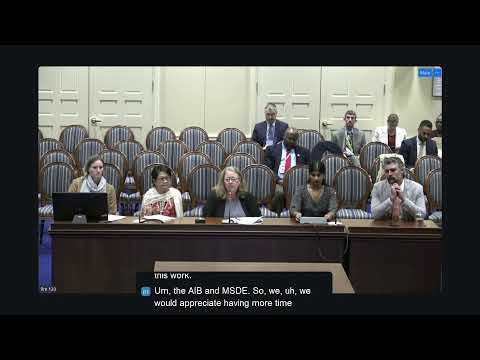
Committee hears testimony on Blueprint amendments; AIB urges longer hold‑harmless and flexibility on expert review funds
Summary
A panel at the Appropriations Committee reviewed amendments to education 'blueprint' legislation, with the AIB asking for a longer hold‑harmless period, flexibility to move expert review team funds for FY27, and clearer reporting timelines; counties and advocates pressed for timely data and retention of technology reporting.
A hearing of the Appropriations Committee covered amendments to bills tied to the Blueprint for Maryland’s Future and related education‑funding provisions, with a panel of education and local government representatives pressing the committee for changes to hold‑harmless language, reporting timelines and how expert review team funds can be used.
Rachel Heis, executive director of the AIB, told the committee that the House and Senate versions differ chiefly on two points: treatment of expert review team (ERT) funds for fiscal 2027 and the length of any hold‑harmless protection. Heis said, “what we proposed for this year is that the funds be allowed to be uh transferred um and used for the um academic excellence program.” She said the Senate allowed that transfer, while the House paused ERT funds and “authorize[d] the use of the ERT funds for other eligible blueprint purposes but not for the academic excellence program,” and asked the committee to consider a fund swap so general funds could support academic excellence while preserving special‑fund balances in other Blueprint programs.
Sarah Sample of the Maryland Association of Counties urged quicker reporting and adoption of amendments that would provide counties the information they need before next session. She summarized the counties’ ask: “the main thing that we just wanted to comment on was that hold harmless extension,” and said counties wanted the report produced sooner so local officials can assess impacts and avoid unintended outcomes for resource‑scarce students.
An advocate who identified herself as Joy said advocates support a longer, community‑based process and recommended a three‑year hold‑harmless paired with a longer reporting timeline, and she urged the committee to retain the technology reporting requirement that would track digital access in counties. Joy said keeping the technology report matters “in an era of um inclement weather, potential asynchronous learning days, digital access is key, especially for educational continuity.”
A participant who identified himself as Spencer RH, a delegate candidate for 9A, described a large projected shortfall and urged substantial program changes. He told the committee, “you’re looking at a $3 billion essentially deficit in the program right now,” and advocated scaling back certain contractors and program expansions to make the Blueprint’s 2027 obligations more affordable for counties.
Committee members sought clarifications about the role of the expert review team versus entities that would address fiscal compliance and indicated they expect to take many of the panel’s suggestions into account during conference negotiations. The panel emphasized they were not asking the committee to abandon Blueprint goals but to provide timing and fiscal flexibility as the state and local jurisdictions implement the law.
The hearing included discussion of technical amendments negotiated among IA, MSDE and DGS to reduce burden on school districts, including raising the project cost threshold that triggers state review and moving facility‑condition reporting from annual to once every four years for districts, and clarifying the content and timing of reports the IEC will provide to LEAs and counties in the capital improvement planning process. Those changes were presented as efforts to reduce district administrative load while preserving county visibility into projected project funding.
The committee did not take final action on these amendments during the bill‑hearing portion; members said they will carry many of these issues into conference and that testimony will be taken into consideration as negotiations proceed.