Get Full Government Meeting Transcripts, Videos, & Alerts Forever!
Get email alerts on the School Accountability topic
No spam. Unsubscribe anytime.
Civic Memorial High earns 'exemplary' rating as district report card shows steady gains and remaining gaps
Summary
At a November board meeting, district leaders highlighted Civic Memorial High School’s exemplary designation on the Illinois School Report Card, showed most buildings scored 'commendable,' and outlined areas for growth — notably student growth measures, math proficiency and chronic absenteeism — alongside planned interventions and data reviews.
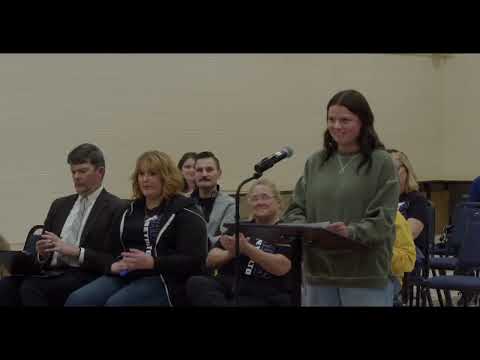
Civic Memorial High School was recognized as an exemplary school on the Illinois School Report Card during the Bethalto CUSD 8 board meeting, while four other district buildings were rated commendable, a district presenter told the board.
The presenter said the report card — based on last year’s data and released Oct. 31 — ranks schools on measures including ELA and math proficiency and growth, science proficiency (tested in grades 5, 8 and 11), graduation rates and ninth-grade-on-track at the high school level, and chronic absenteeism (defined in the report as missing 18 or more days, or 10% of the year). “This award places CHS among the top performing high schools in the state,” the presenter said when announcing the high school’s designation.
Board members and administrators framed the results as part of a continuous-improvement cycle. The presenter noted that for some elementary schools, certain indicators (English-language-learner counts, science testing and the climate survey) are not reported because the school lacks the required subgroup size; when those three indicators are absent, the percentages are redistributed and chronic absenteeism carries a heavier weight in the overall score.
The board discussed statewide changes to scoring. District leaders explained the state’s so-called “right-sizing” increased the cut scores for science proficiency between the 2023–24 and 2024–25 school years, making proficiency harder to attain and contributing to declines that are at least partly methodological rather than purely instructional.
Math proficiency and growth were identified as continuing concerns. The presenter and board referenced national and statewide declines in math after COVID and said the district will examine interventions in a January data review. Administrators highlighted targeted actions already underway: expanded use of Eagle time in elementary schools, intervention teams that follow students between buildings, a targeted after-school tutoring intake to lower the barrier for students to attend, and a data platform (Edge Climber) used to track student histories.
Attendance was singled out as a lever for improvement. The presenter explained the district’s approach to chronic absenteeism and previewed that the state will shift next year to reporting a positive “students in attendance” measure (for example, turning a 15% chronic-absenteeism rate into an 85% attendance rate), which the district anticipates will make conversations with families more constructive. Building principals reported modest attendance gains at some schools and described incentives and family outreach programs aimed at improving daily attendance.
The presentation closed with district leaders signaling next steps: a fuller data-quality review in January, collaboration across building guiding-coalition teams, and continued emphasis on targeted interventions to translate the report-card findings into improved growth scores.
What’s next: The district will provide a more detailed data briefing in January and continue to report progress to the board as interventions and monitoring efforts proceed.