Get Full Government Meeting Transcripts, Videos, & Alerts Forever!
Get email alerts on the Development Inspection topic
No spam. Unsubscribe anytime.
Clark County outlines development-inspection requirements, timelines and fees for builders and homeowners
Summary
Clark County Development Engineering staff explained how to apply for a Development Inspection (DIN) case, the documents required (including the Cecil certificate when applicable), how fees are calculated, and the county’s review and turnaround timelines.
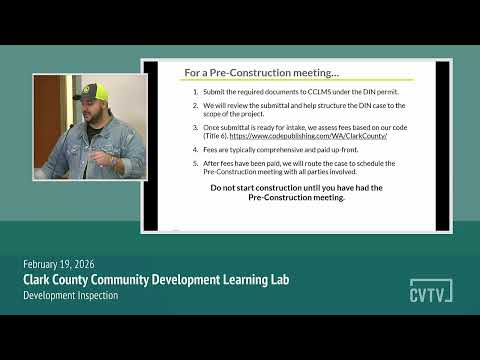
Emil Haddad, with Clark County Development Engineering, told attendees that a Development Inspection (DIN) case is required when grading or stormwater thresholds are met and is intended to ensure public health, safety and durable, maintainable infrastructure. "Do not start construction, please, until you've had the meeting with us," Haddad said, advising applicants that the pre-construction meeting and the required erosion inspection must be complete before breaking ground.
Haddad said the county uses a Land Management System (Klemz) for DIN submissions; applicants must create an account, complete a DIN application and upload required documentation such as an authorization letter when someone submits on an owner's behalf. He emphasized accuracy in application fields — parcel number, square footage, disturbed area and quantities — because DIN fees are collected up front and fee amounts are derived from those submitted quantities.
The staff identified several common triggers for a DIN case, including short plats (2–9 lots), new subdivisions, commercial site plans, drainage projects, stockpile permits and residential work on tax lots. Haddad gave an example: grading on a site under one acre that moves more than 50 cubic yards of earth typically requires a grading permit and related DIN review.
On erosion control, Haddad said the county requires submission of a Certified Erosion and Sediment Control Lead certificate ("Cecil") where applicable and will verify the certificate's active status; the uploaded certificate must show the holder, certification date, expiration and identification number. Haddad added that smaller homeowner projects may allow the homeowner to act as their own Cecil when the site is under one acre.
Haddad walked through the Notice of Final Construction Approval and required plan sets: applicants must upload the full approved engineering/grading plan set plus a reduced 11-by-17 set for drop-off, and include the construction approval letter and required certificates. He noted that when substantial changes occur in the field, those changes must be identified and shown on the as-built or record drawings submitted for final review.
Why it matters: Accurate applications and complete submittals reduce rework, help the county estimate fees correctly, and speed projects from review to construction. Haddad said the engineering review has a minimum seven-day turnaround from receipt of final sets, but corrections restart the review clock and can extend total review time.