Get Full Government Meeting Transcripts, Videos, & Alerts Forever!
Get email alerts on the Master Schedule topic
No spam. Unsubscribe anytime.
High school outlines eight‑block schedule and optional community lunch to expand student choice
Summary
Oyster River High School administrators presented an eight‑block master‑schedule proposal that would convert advisory/flex into a full academic block to create more elective slots, add PLC time for teachers, and propose a one‑hour community lunch where students choose flex, clubs, or enrichment. No decision was made; a range of pilots and a January deadline for block count were discussed.
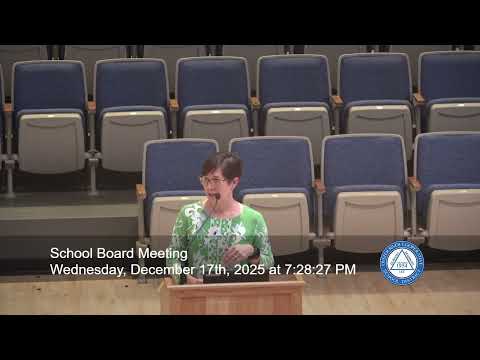
Oyster River Coop School District administrators laid out detailed options Dec. 17 for changing the high school master schedule, emphasizing more student choice and time for curriculum work.
Rebecca Noi, presenting for the high school, said the district is considering an eight‑block day that would move advisory and flex out of the current B2 block and convert that slot into a full academic period. "If we moved advisory and flex, it would add an opportunity," Noi said, explaining that the extra block would allow freshmen and other students to fit electives such as art or world language without losing required courses. She said freshmen would likely be advised to take a study hall in year one to ease transition.
Administrators framed the change as an attempt to align daily time with district values — personalization, relationship building and academic support — and to reduce what surveys called "too much flex." The eight‑block plan would create more scheduling slots for singleton courses (one‑section electives) and allow teachers to use one block for PLCs and curriculum development.
One of the proposal’s most visible features is a one‑hour "community lunch," during which students could eat, attend clubs, access enrichment, or use flex. Noi described logistical options discussed with food service, including kiosk points of service and multiple serving lines to prevent bottlenecks. "We would actually have kiosks; we would have different places in the building," a staff member involved in planning said.
Board members raised operational questions about supervision, how lunch and flex minutes would be scheduled, and how students in need of mandated supports would be accommodated. Administrators said teachers would retain contractual prep time and that the eighth block could be used for common planning: "In that eighth block, they get two preps, one prep on each day," an administrator explained, adding that PLC time for departments could be scheduled there.
Noi and other administrators repeatedly emphasized that the ideas are still under consideration. She outlined the stakeholder process so far — consultant meetings, teacher and department feedback, student senate discussions and voluntary staff meetings — and said the district is listening to students and staff as it prototypes options. A staged pilot or test run was discussed as a way to identify logistical issues before full implementation.
Next steps: administrators said a decision on how many blocks to run would need to be made by the end of January to feed the master‑schedule build in PowerSchool and allow students to select classes in February. No formal vote was taken on the schedule that night.