Get Full Government Meeting Transcripts, Videos, & Alerts Forever!
Get email alerts on the River Management topic
No spam. Unsubscribe anytime.
Bureau of Reclamation outlines Corrales river‑stabilization plan, warns of short scheduled diversions
Summary
The U.S. Bureau of Reclamation told Corrales Village Council it will raise the riverbed by about 2–3 feet, build side channels and install grade‑control features to stabilize an incised reach; the first planned river diversion is set for March 3 with later diversions timed to avoid irrigation season.
Jan (Jen) Kobi, a civil engineer and project manager with the U.S. Bureau of Reclamation, told the Corrales Village Council on March 2 that the agency is moving forward with the Corrales River (Corralas/Corales) maintenance project to reduce erosion, stop lateral migration toward levees and restore river‑channel function.
Kobi said the river in the reach near the Corrales siphon is deeply incised — 15–20 feet below the floodplain in places — and that this incision has increased erosion and the risk of levee breach. "When we see that two‑year water mark leading to lateral migration and intense protection of levees and riverside drains, we have to act," Kobi said.
The primary goal, she said, is bank stabilization to reduce the risk of levee failure and to restore ecosystem functions. Planned interventions include constructed side channels, grade‑control structures, bed‑raising of roughly 2–3 feet to increase groundwater levels, and localized bank protection. Kobi said the project will typically phase work rather than doing all tasks at once, but because this reach is heavily incised the team is using a combined approach to achieve more benefit from the work.
The presentation included a timeline for three planned river diversions tied to phases of construction: the first diversion is scheduled for March 3 to place a cover dam and route flow into a constructed channel; a second diversion is targeted for May or June depending on construction sequencing; and a third diversion will be postponed until after the irrigation season to avoid interfering with local irrigators. Kobi said the team will coordinate with the Middle Rio Grande Conservancy District (MRGCD) and other flow managers to schedule diversions during lower flow windows.
Kobi also warned that part of the first diversion route crosses private PBLO reservation land. When the river is routed across that land, paddlers and river users will not be able to disembark on private property. "We're going to have signage a mile up, at the diversion and visible markings," she said, adding that the project team will coordinate with the fire chief and local emergency responders to ensure rescue access and safety.
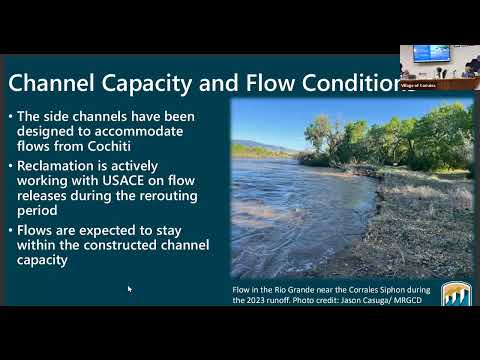
Kobi said the constructed side channel design is sized to handle expected runoff flows and that if high flows exceed channel capacity the team will move the river back into the main stem to avoid overbanking. She emphasized ongoing coordination with MRGCD on flow regulation, and with the Pueblo/landowners where the diversion temporarily routes river traffic.
The council questioned timing and whether phase 3 meant a November window; Kobi said the sequence will follow irrigation season constraints and contractor availability. She acknowledged that crews will try to avoid costly demobilizations that would increase taxpayer expense. Kobi closed by saying the project is driven by public‑safety authority the Bureau holds for the Middle Rio Grande reach and by the need to slow lateral migration and protect infrastructure.
What happens next: Kobi said the first diversion will proceed March 3 subject to the flow coordination already planned with MRGCD and other agencies; the project team will post signage and work with emergency services ahead of the diversion.