Get Full Government Meeting Transcripts, Videos, & Alerts Forever!
Get email alerts on the Data Centers topic
No spam. Unsubscribe anytime.
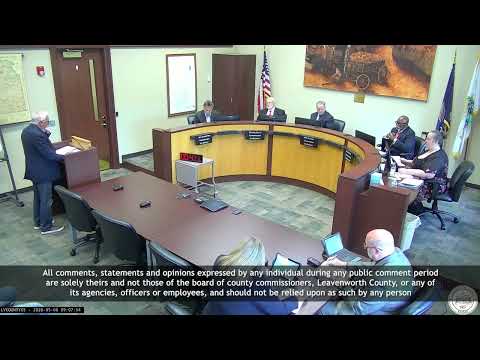
Leavenworth County hears intense public opposition to Project Bluestem, debates moratorium and adopts developer‑funded review agreement
Summary
After hours of public comment opposing Project Bluestem, Leavenworth County commissioners reviewed draft data‑center regulations, debated a 90‑day moratorium that failed, and approved a developer‑funded account to pay third‑party review costs while staff prepares formal rules.
Leavenworth County commissioners spent the bulk of their meeting hearing residents oppose a proposed hyperscale data‑center campus called Project Bluestem and reviewing draft county rules intended to limit the projects’ local impacts.
Residents repeatedly urged the board to pause action. “Do not rush. Do not assume. Do not approve first and ask questions later,” said Jim Carlskin, a Tonganoxie resident, calling for a moratorium, identification of the end user, independent engineering reviews and aquifer‑impact studies before the county commits roads, utilities or zoning changes.
The board then discussed a draft ordinance prepared by planning staff that would either create a standalone technology district or add standards to existing industrial districts. John Jacobson, director of planning and zoning, said the draft requires developers to submit preliminary site studies — including phase‑1 environmental, threatened‑and‑endangered‑species, traffic impact, ambient sound and a utility service‑availability letter — and to use closed‑loop cooling where possible. “All data centers’ cooling must be in the form of a closed loop system or more efficient technology to limit water usage,” Jacobson said.
Staff also proposed noise controls and post‑construction verification. Under the draft, field verification of post‑development noise would be required for certificates of occupancy; staff recommended that post‑development levels may not exceed 55 decibels above the pre‑development baseline at the property line and that additional screening would be required if that limit is exceeded. “Field verification of post development noise levels will be required for the issuance of any full or partial certificate of occupancy,” Jacobson said.
Public speakers questioned key technical and enforcement points. Commenters raised concerns about potential water use, generator emissions and 24‑7 noise; county residents and environmental advocates said the local benefits — mainly construction jobs and developer‑promised infrastructure — did not justify long‑term utility and environmental impacts. Zach Pastora, a Sierra Club director, urged the county to require community engagement and to consider alternative projects such as battery storage facilities that held more local buy‑in.
The board split on how to respond. Chair (S1) moved a 90‑day moratorium intended to stop new applications and pause project facilitation while the county finalized regulations and conducted further study. Commissioners debated whether a moratorium would block staff from seeking information; supporters said it would prevent behind‑the‑scenes commitments, while opponents warned it could slow the board’s ability to gather independent technical expertise. The moratorium motion failed on the floor (more no votes than yes).
Separately, commissioners approved a developer‑funding mechanism to cover third‑party review costs. Planning staff described an agreement in which the developer’s corporate entity would prefund $450,000 into an account to pay for consultants and technical reviews, with a maximum cap noted in the draft of $500,000; unused funds would be returned. That motion passed by a 3–2 vote. Supporters said the arrangement ensures independent technical work is paid for; critics said accepting developer money risks advancing the project before county rules are final.
The board also approved a $10,000 local match for a Leavenworth County mobility study with the Kansas City Area Transportation Authority; KCATA will seek grant funding to cover the bulk of the study costs.
What’s next: planning staff will bring the draft regulations through the public review process and to the planning commission for hearings; commissioners said they expect additional work sessions and technical input from utilities, the Kansas Corporation Commission and other agencies before adopting final rules. The developer funding account will allow third‑party studies to proceed while the regulatory process continues.