Get Full Government Meeting Transcripts, Videos, & Alerts Forever!
Get email alerts on the Land Use topic
No spam. Unsubscribe anytime.
Northlake council adopts thoroughfare realignment and delegates most plat approvals to staff
Summary
The Northlake Town Council unanimously approved changes to the master thoroughfare plan to reroute commercial traffic and adopted an amendment to the Unified Development Code that allows administrative approval of most plats under new state rules (HB 3699), with monthly reporting to Planning & Zoning.
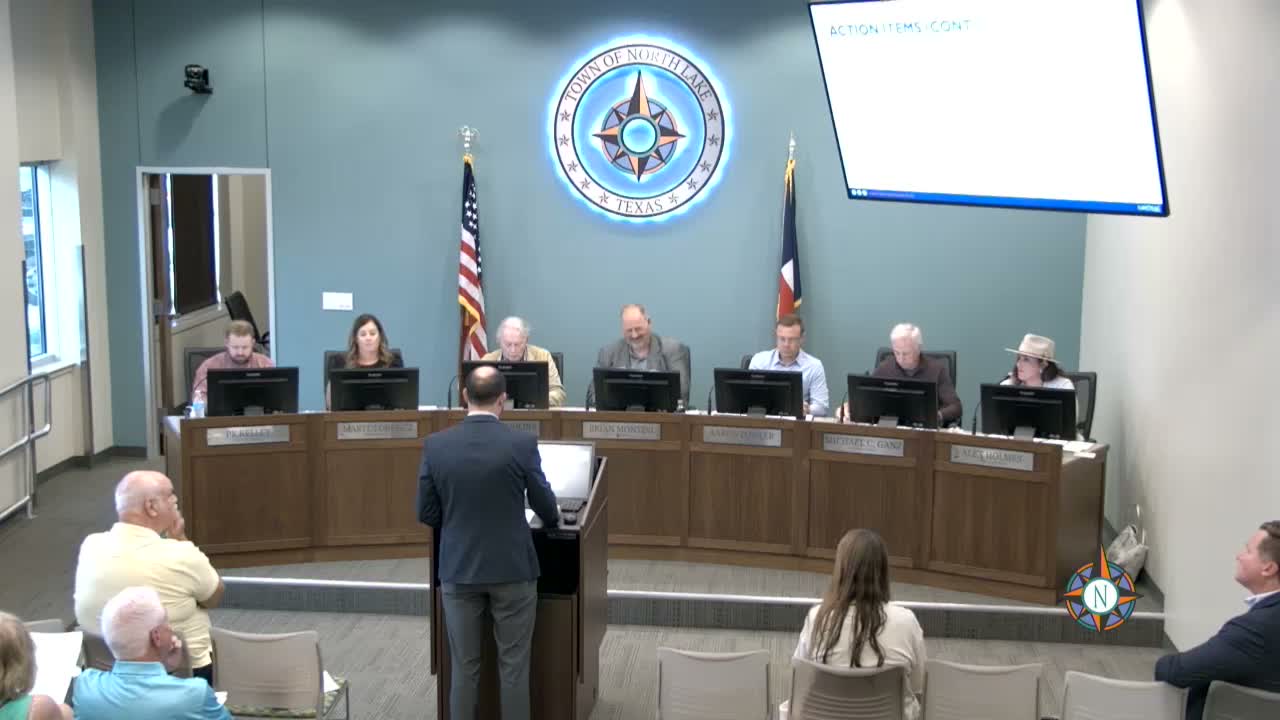
The Northlake Town Council on May 23 approved a master thoroughfare plan amendment and a Unified Development Code change that will shift some plat‑approval authority from Planning & Zoning to staff.
Planning staff presented the thoroughfare amendment as a targeted realignment northeast of FM 407 and Faught Road and south of FM 1171 intended to concentrate heavy commercial and truck traffic at a single, signalized intersection and to avoid multiple truck crossings near residential areas. Staff said the revised alignments reduce flood‑plain crossings and better separate industrial traffic from planned residential and retail areas. The council opened a public hearing, thanked nearby residents for engagement, and voted unanimously to approve the amendment.
On subdivisions, staff briefed council on House Bill 3699, which tightens statutory timelines for plat approvals and allows broader delegation of administrative approval. Planning & Zoning unanimously recommended Option 2: allow administrative approval for most plats while requiring staff to provide monthly reports to P&Z and routing any plat requiring waivers or variances to P&Z (and council) for consideration. Council held a public hearing (no speakers) and voted unanimously to adopt the administrative approval approach. Staff said the change is intended to reduce delay caused by the statutory 30‑day 'shot clock' and to let staff deny plats within the shot clock window rather than waiting for a commission agenda.
Why it matters: the two actions are designed to accelerate development review while maintaining oversight for nonconforming or waiver‑requiring plats. Council members emphasized the balance between speeding approvals and preserving opportunities for commissioners to raise substantive design issues during preliminary review; staff said that monthly reporting and targeted review at final plat stages will provide that oversight.
Council next steps: staff will return with implementing ordinance language and the updated monthly reporting process; the changes take advantage of the state law changes but preserve a pathway for public review where waivers or variances are requested.