Get Full Government Meeting Transcripts, Videos, & Alerts Forever!
Get email alerts on the Regional Sewer District topic
No spam. Unsubscribe anytime.
Boone County commissioners table choice of preferred sewer infrastructure amid funding questions
Summary
The board delayed selecting a preferred infrastructure alternative for the proposed Boone County Regional Sewer District, citing missing lifecycle cost estimates, bonding options and uncertainty about expansion to Thorntown; staff said a preferred alternative is required for the state petition but further fiscal detail is needed before a decision.
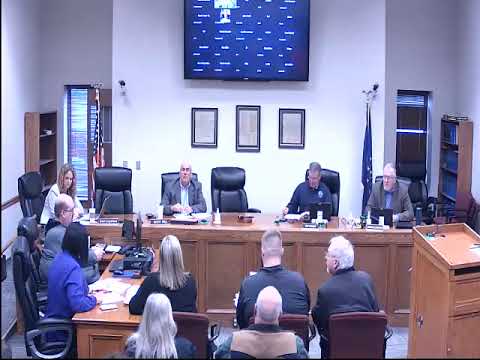
Boone County commissioners on March 23 voted to table a resolution that would have selected a preferred infrastructure alternative for a proposed Boone County Regional Sewer District, saying they need more detailed financial analysis before narrowing to a single option.
Commissioners discussed three alternatives presented to the board: a smaller, expandable plant (described in the meeting as roughly $16.8 million for an initial plant serving the 47 Commons with capacity to grow toward Thorntown), and two larger options read in the discussion with estimated orders of magnitude described in the meeting as about $40 million and $50 million for alternatives that would serve Thorntown directly. Several commissioners said they lacked lifecycle cost estimates, bond options and clarity about the implications for the county’s capital plan.
Lana (management) told the board the chosen alternative would be part of the county’s petition to form the regional sewer district and that funding typically combines bonds, rates and potentially state revolving funds. "These projects would ultimately be funded by the regional sewer district that you're petitioning to form ... we need to understand which alternative the commissioners prefer," she said.
Commissioners debated the trade-offs. One member said building a smaller, expandable plant could get initial work moving and protect previously approved investments at 47 Commons, while others said splitting the program to add Thorntown later could complicate bonding and raise total costs. After exchanging views and asking staff for additional numbers and bond scenarios, the board voted to table the resolution and revisit it at a future meeting once staff provides more detailed lifecycle cost estimates, funding options and a clearer capital plan.
Next steps: staff will prepare refined cost estimates, funding and bonding scenarios and a recommended presentation for the board’s next meeting. The board recorded a motion to table the resolution; no final selection or binding action was taken.