Get Full Government Meeting Transcripts, Videos, & Alerts Forever!
Get email alerts on the Municipal Building Financing topic
No spam. Unsubscribe anytime.
Montgomery officials unveil $10M plan for combined city hall and police station, say sales tax district will cover much of police cost
Summary
City officials presented designs for a roughly $10 million municipal building that would combine city hall and an expanded police department; police leaders said a Crime Control and Prevention District (CCPD) sales-tax fund could cover about $7 million of the police portion, while residents sought clearer answers about water/sewer funding and potential tax impacts.
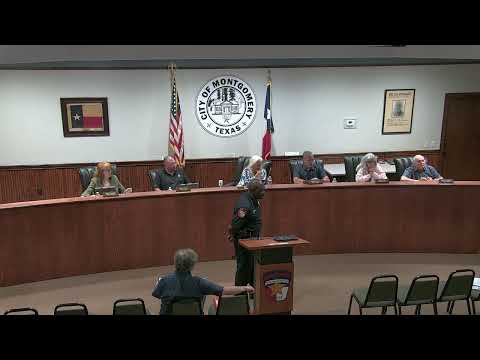
City officials on Thursday showed residents preliminary designs and financing plans for a proposed municipal building that would combine an expanded city hall and police station, saying sales-tax revenue from a local Crime Control and Prevention District would pay most of the police portion.
John Stevens, the project architect with MC Group, told the City Council workshop the adaptive reuse plus addition would yield roughly 35,000 square feet, including court windows, a council chamber, evidence storage, and holding cells. "So, all in all, it's about 35,000 square feet," Stevens said as he reviewed floor plans and renderings.
The police chief, referred to in the meeting as Brent, said the city has been planning for additional police capacity since late 2023 and that the Crime Control and Prevention District — a sales-tax mechanism voters approved last year — is the primary revenue source for policing costs. Brent said last year’s CCPD receipts were about $500,000 and that this year’s projection is roughly $862,000. He also said the city used about $180,000 annually from that sales-tax stream to purchase the existing hardware-store property for reuse. "It's no tax. There's no tax raising to the citizens of Montgomery," Brent said when asked whether property taxes would be increased for the project.
Brent estimated approximately $7 million of the police portion could be paid from CCPD proceeds; staff said the total project estimate in planning is about $10 million, including furnishings and systems. The council and staff described possible financing via a certificate of obligation or similar debt instrument and noted proceeds from recent or pending municipal property sales could help cover several million dollars of the general-fund share.
Residents pressed city leaders for clearer budgeting and trade-offs. Mark Guest, a public commenter, asked officials to explain the project's value proposition for residents and whether the new space would yield more efficient services or public meeting space. Several speakers questioned whether allocating sales-tax revenue to CCPD reduces funds that previously supported economic development (referred to in the meeting as MEEDC/MEDC) and whether that shift would limit water and sewer projects.
Staff and the chief responded that utility (water/sewer) funds are separate enterprise funds and are not paid for by the CCPD sales tax, but multiple participants requested more transparent documentation of how the various sales-tax and general-fund streams would be apportioned. "We have a water plant that needs to be built. We have a sewer plant that needs to be built. And we have needs with the police department. Can we satisfy those needs? And can we do it responsibly?" one council member said.
Operational benefits were a central justification for police leaders. The chief said having local holding capacity and integration with a statewide warrants/payment system improves collections and reduces the time officers spend transporting arrestees to county facilities; he estimated lost revenue of about $27,000 a year from the prior practice. Officials also discussed space needs for evidence storage, dispatch, training rooms, and drone operations.
Residents asked about ancillary features such as an incinerator for drug evidence and environmental safeguards; staff said any incinerator would be subject to state regulation and filtration requirements and that environmental studies and monitoring would be performed as required. Questions about parking and public access were discussed as well; staff said the current site had about 87 parking spaces and the redevelopment would expand parking, though transcript figures were inconsistent and staff committed to provide clarified counts.
Council members said the design and cost estimates are preliminary; the city intends to hire a construction manager to obtain firm bids and will present financing options, including the split between CCPD-funded police costs and the general-fund share, for council approval. A motion to adjourn followed later in the agenda and carried by voice vote.
Next steps: staff will provide more detailed cost breakdowns, clarify which funds will pay which elements of the project, refine parking counts and environmental analyses, and present formal financing options to the council for future action.