Get Full Government Meeting Transcripts, Videos, & Alerts Forever!
Get email alerts on the Recovery Needs topic
No spam. Unsubscribe anytime.
Residents and volunteers describe rescues and looming recovery needs; city outlines steps and funding uncertainty
Summary
Community members from Wua and Kahuku told the council they conducted lifesaving rescues, are now shifting to cleanup and rebuilding and need materials, pumps and environmental testing; city officials said debris removal is about 80% complete and that FEMA documentation is under way but funding (including a presidential disaster declaration) is not yet certain.
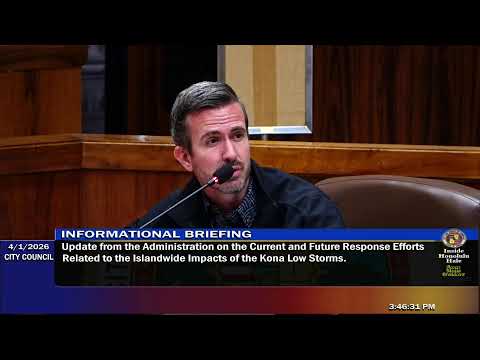
Residents, volunteers and neighborhood leaders told the Honolulu City Council on April 1 that community-led rescues and cleanup were essential during the March Kona low storms and that significant recovery needs remain.
Preston "Bruski" Lewis, a Wua resident who helped pull families from flooded homes, described neighbors and local farmers using personal equipment to perform rescues and begin cleanup. "We already are at the rebuilding stage," Lewis said, asking the city for lumber, drywall and tradespeople to help permanently repair homes.
Other public testifiers praised the cityfor staging resources but urged clearer, earlier public communications and local hubs for distribution of food, water and supplies. Several speakers raised public-health concerns about contaminated water and airborne dust after mud-drying, and asked the city to coordinate air, water and soil testing to preserve evidence for federal reimbursement and to protect volunteers and residents.
"Samples need to be taken now and preserved in the appropriate way," neighborhood representative Denise Santelini told the committee, asking the city to lead environmental-sampling efforts.
Managing Director Mike Formbby and DEM Director Randall Collins acknowledged the magnitude of the cleanup and recovery work. Formbby told the council the city was operating under an incident action plan and that debris-removal efforts were roughly "80%" complete in places; he said the administration is beginning the fiscal recovery stage and is working with state and federal partners to document damage and secure reimbursement.
Officials reiterated they were working with FEMA staff on-island to document damage and that the city did not yet have a presidential disaster declaration. "A small mistake can keep you from getting reimbursement," Formbby told the committee, emphasizing the need for precise documentation.
Council members asked for expedited decisions on sheltering, placement assistance and targeted pumps and equipment for communities still blocked by mud and debris. Several council members and speakers urged the administration to provide councilors better access to the EOC's virtual dashboard and to pre-position common supplies for future events.
No formal legislation or funding decisions were made at the hearing. The council asked the administration to supply a prioritized list of immediate physical needs (pumps, roll-offs, building materials), a schedule for environmental testing and a timeline for the after-action report and FEMA documentation.
The committee will reconvene when officials produce the requested documentation and the after-action review is ready to present.