Get Full Government Meeting Transcripts, Videos, & Alerts Forever!
Get email alerts on the Historic Preservation topic
No spam. Unsubscribe anytime.
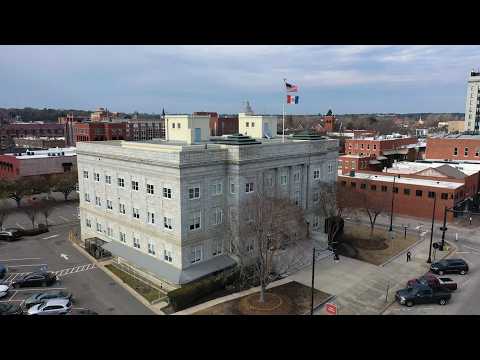
Cumberland County’s 1926 courthouse on Gillespie Street remains a civic landmark
Summary
The neoclassical Cumberland County courthouse, built 1924–26 after the prior courthouse became too small, still houses county zoning and plan inspections and retains original fixtures; the courtroom was restored in 2004 and the building is listed on the National Register of Historic Places.
The neoclassical Cumberland County courthouse on Gillespie Street was built beginning in 1924, completed in 1925 and opened in 1926 as the county’s new seat of government, a presenter narrating the site said. When it opened, the county’s population was about 35,000 and most county offices — from the sheriff’s office to the register of deeds and the jails located on the upper floors — operated from the building.
The presenter described original fixtures throughout the first-floor hallways and said the second-floor courtroom still has its original chandeliers. Behind the judge’s bench, the narration identified a portrait labeled in the tour as Sheriff Neil Hector Mcichi, who the presenter described as having served from 1910 to 1950.
The courtroom was originally heated by a coal furnace in the basement, and the presenter pointed to stained wood paneling near vents that the narration attributes to years of coal dust. The presenter said rapid population growth — roughly 35,000 at opening to nearly 100,000 by 1950 — strained the building’s capacity and led the county to construct additional courthouses later in the 20th century.
According to the narration, the courtroom fell into disrepair by 2004; county staff cleaned and restored it near its original condition for a county anniversary. The presenter said the restored room is now used for zoning meetings, occasional traveling court sessions and other government functions, while the plan inspections and zoning departments remain on the first floor.
The narration states the building is listed on the National Register of Historic Places and is part of the downtown historic district. The courthouse’s mix of ongoing government use and preserved architectural features makes it a continuing civic resource and a focal point for local historic preservation efforts.