Get Full Government Meeting Transcripts, Videos, & Alerts Forever!
Get email alerts on the Emergency Management topic
No spam. Unsubscribe anytime.
Council presses city on evacuation timing and chain of command after Oahu flash floods
Summary
Council members at a Honolulu executive management hearing questioned emergency managers about why evacuation guidance and EOC activation followed weather-service alerts rather than earlier stream-gauge surges, while DEM leaders said real-time data, night conditions and multiple decision factors complicated immediate action; an after-action report was promised.
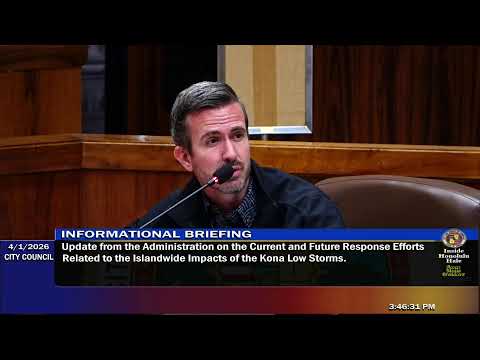
Honolulu City Council members pressed city emergency managers on April 1 about why evacuation guidance and Emergency Operations Center (EOC) activation did not occur earlier during the Kona low storms that caused widespread flooding across Oahu.
Chair Waters convened the committee and framed the session as a fact-finding hearing to establish "the who, what and when" of the city response. Council members cited early stream-gauge spikes and asked why the city did not issue evacuation notices earlier in parts of Wua and other flood-prone areas.
"We activated at 11," Managing Director Mike Formbby said, referring to the decision after a 10:57 p.m. National Weather Service flash-flood advisory. Formbby and other administrators told the committee that activation and evacuation decisions draw on multiple inputs — reservoir and dam readings, weather forecasts, first-responder reports and stream gauges — and require judgment calls about available evacuation time and where to send people safely.
"It is the totality of the information that you're receiving and inputting," Director Randall Collins of the Department of Emergency Management told council members, explaining the city's reliance on incident command at the tactical level and EOC coordination at the multi-agency level.
Council members repeatedly returned to the same question: why did some gauges show rapid rises hours earlier without triggering broader action? "It just doesn't seem like all the data that's available...was incorporated into that analysis," Council Member Wire said, citing community reports that stream gauges had surged well before 11 p.m.
DEM officials said the city had duty officers on call, that some gauges refresh slowly or sporadically, and that the EOC only fully stood up after the NWS upgrade to a flash-flood warning. Collins acknowledged the system depends on operator inputs and that duty officers receive reports from dispatch, and he identified notification and monitoring gaps as areas for improvement.
Council members requested a minute-by-minute after-action timeline, asking the administration to document who made each decision and when. "When we get to the after-action report, we will be in a better position to go minute by minute, hour by hour," Formbby said. He and Collins pledged to provide detailed logs and to return to the council once the after-action work is complete.
The hearing did not produce formal votes or directives. Officials emphasized that rapid, unpredictable rainfall patterns complicated forecasting and that evacuation orders must balance safety with where evacuees can shelter and how first responders can reach them. Formbby said the city is working closely with FEMA and that documentation for a potential presidential disaster declaration is ongoing but not yet finalized.
Council members said they want clearer public and council-facing communications from the EOC, better multilingual alerts and faster, more precise triggers for future evacuations. The committee asked the administration to provide the requested after-action materials and to brief the council again once those materials are finished.
The committee also set out follow-up topics for the next hearing: the virtual EOC dashboard, shelter staffing and the role of stream-gauge monitoring in future operational triggers.