Get Full Government Meeting Transcripts, Videos, & Alerts Forever!
Get email alerts on the Court Rules topic
No spam. Unsubscribe anytime.
Bar Association board approves committee comments on proposed court-rule changes
Summary
The Bar Association board voted to approve and forward the court rules committee's comments on proposed changes to CR 4.2, CR 4.7 and GR33. The recommendations clarify a $100,000 fine for certain trafficking charges, adjust discovery redaction procedures, and raise funding concerns for expanded appointment-of-counsel provisions.
At its meeting, the Bar Association board voted to approve the court rules and procedures committee's comments on proposed amendments to criminal rules CR 4.2 and CR 4.7 and General Rule 33 and to forward those comments to the Supreme Court.
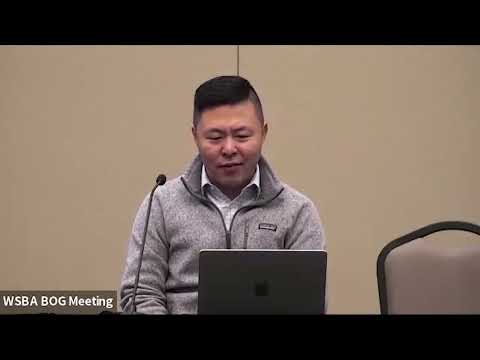
Andrew Y, chair of the court rules and procedures committee for fiscal year 2025'026, presented the committee's recommendations and explained the rationale for each change. "The committee is proposing that we revise paragraph 6R to clarify that if a defendant is originally arrested for trafficking in the first degree or trafficking in the second degree under RCW9A4100, then the court shall impose a fine of $100,000," he said. The committee said the clarification is intended to confine the provision to trafficking under RCW9A4100 and avoid applying it to other trafficking offenses.
The committee also recommended replacing the term "accused" with "defendant" throughout a proposed revision to CR 4.7 for consistency, and proposed a timeline for redacted discovery: defense counsel would provide prosecutors with a copy of redacted discovery before providing it to clients. For the courts-of-limited-jurisdiction version of 4.7, the committee recommended allowing defense counsel to provide redacted discovery to a client without a prosecutor or city attorney's preapproval if the listed items are redacted, while letting a prosecutor move in court within seven days to modify redactions. The committee further proposed permitting defense counsel to ask the court to modify redaction conditions without a specified time limit.
The committee devoted substantial attention to proposed changes to GR33, which the presenter described as an "access to justice" rule. The proposed GR33 would define a financial barrier for a person with a disability as an access barrier potentially eligible for accommodation and would treat a litigant's self-identification of access barriers as presumptively sufficient to support a request for appointment of counsel. The committee cited a disability justice task force report that, it said, found many courts indicated mandatory appointment of counsel could significantly affect court budgets, but the proposed rule does not identify a funding mechanism. When asked for an estimate of county costs, Andrew Y said, "I don't have any kind of estimate or study on on that issue."
A board member asked whether a lay reader would interpret the term "disability" narrowly (for example, as a physical disability) and urged the committee to clarify funding mechanisms and other standards in GR33. The committee acknowledged that the rule seeks to reduce documentation requirements and presumptively ease access to accommodations but cautioned that removing gatekeeping steps could strain courts with limited resources.
After discussion, a board member moved and another seconded a motion to approve the committee's comments as presented and forward them to the Supreme Court. The board conducted a roll call vote. Board member Mary Wthbell voted no; Tom Ahern voted no; Allison Whitney voted no. The remaining members present voted yes. The motion passed with three negative votes and will be forwarded to the Supreme Court.
Board members thanked Andrew Y for leading the committee and presenting the proposed comments. The board proceeded to other business after the vote.