Get Full Government Meeting Transcripts, Videos, & Alerts Forever!
Get email alerts on the Franchise Excise Tax Exemption topic
No spam. Unsubscribe anytime.
Tennessee Department of Revenue outlines franchise and excise tax exemption rules for investment entities
Summary
The Tennessee Department of Revenue explained eligibility and filing rules for franchise and excise tax exemptions for certain investment entities under Tennessee Code Annotated §67-4-2008, including 90% asset and income thresholds, required forms (FAE-183, FAE-170), filing deadlines, a $200 late-filing penalty, and contact resources.
Meagan Choate, Taxpayer Services Supervisor at the Tennessee Department of Revenue, presented a webinar explaining how certain investment funds may qualify for a Tennessee franchise and excise tax exemption.
Choate said the exemption applies to entities that are "a limited liability company, a limited partnership, a limited liability partnership, or a business trust." She cited Tennessee Code Annotated §67-4-2008 as the governing statute. To qualify, she said, "at least 90% of the cost of the entity’s total assets must consist of qualifying investment securities, bank deposits, and office space and equipment," and "at least 90% of the entity’s gross income must also consist of interest, dividends, and gains from the sale or exchange of qualifying investment securities."
Choate explained the entity’s primary purpose must be buying, holding, and selling qualified securities on its own behalf, not acting as a broker, and that capital must be derived primarily from investors not affiliated with the fund. She directed viewers to file form FAE-183 (Application for Exemption or Annual Exemption Renewal) to request the exemption or to renew it annually.
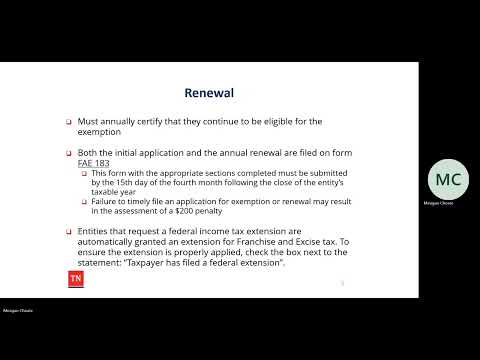
If an entity does not meet the exemption requirements for a given year, Choate said it will be taxable for that year and must file the franchise and excise tax return (form FAE-170) electronically and pay any taxes due. She stated the return and the initial and renewal FAE-183 applications are due "by the fifteenth day of the fourth month after the entity’s year end." She also warned that "failure to timely file an application for exemption or renewal may result in the assessment of a $200 penalty."
Choate noted that entities granted a federal income tax extension are automatically granted a state extension for franchise and excise tax if the taxpayer checks the box indicating they filed the federal extension. For more detail, she referred viewers to form FAE-183, form FAE-170 and its instructions, Tennessee Code Annotated §67-4-2008, and the Franchise and Excise Tax Manual, all available on the Tennessee Department of Revenue website.
The presentation closed with contact information for taxpayer assistance: the department website (tn.gov/revenue), email revenue.support@tn.gov, social media channels, and phone lines (general tax line 615-253-0600; franchise and excise questions 615-253-0700). Choate said phone assistance is available Monday through Friday, 8:00 a.m. to 4:30 p.m. Central Standard Time.