Get Full Government Meeting Transcripts, Videos, & Alerts Forever!
Get email alerts on the Obligated Member Entity topic
No spam. Unsubscribe anytime.
Tennessee Revenue explains who qualifies for Obligated Member Entity election and filing steps
Summary
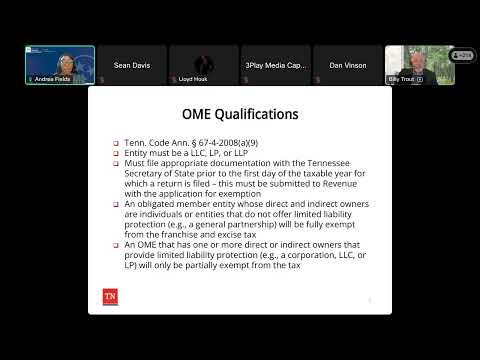
Tennessee Department of Revenue officials outlined how the Obligated Member Entity (OME) election can provide pass-through treatment for franchise and excise tax, detailed qualifying entity types (LLC, LP, LLP), required Secretary of State filings, key deadlines, and how the election affects limited liability.
Billy Trout, Taxpayer Education with the Tennessee Department of Revenue, opened a departmental webinar describing the Obligated Member Entity (OME) election as a way to obtain pass-through tax treatment for franchise and excise taxes.
"The purpose of this OME election-- it's to obtain a pass-through tax treatment," Trout said, adding that the election is intended to "avoid duplication of taxation" under Tennessee law.
Why it matters: The department said OME can prevent an entity and its members from being taxed twice at the entity level, but only certain business types and properly timed filings qualify. The session cited Tennessee Code Annotated 67-4-2008 as the statutory basis for the OME provisions.
Who can elect and how it works: Department officials said only limited liability companies (LLCs), limited partnerships (LPs), and limited liability partnerships (LLPs) may make the election. Trout said all members must make the election for it to be valid: "If one or more members doesn't make the election, then it's not a valid OME election." Andrea Fields, Taxpayer Services supervisor, reiterated that entities must file the obligated-member amendment with the Tennessee Secretary of State before submitting the Department of Revenue's application form (FAE 183).
Deadlines and filing mechanics: Trout reviewed timing rules for taxpayers. Franchise and excise tax returns generally are due by the 15th day of the fourth month after the tax year ends (typically April 15 for calendar-year filers). Fields said an applicant may submit the FAE 183 as early as January 1 for that tax year and that federal extension filings are recognized for the OME renewal when properly indicated on the form or in TNTAP, the department’s electronic filing system.
Documentation and certification: The presenters described notarization and signature requirements for amendments: limited partners and LLP members must sign and notarize appropriate amendments; LLC articles or amendments must identify all members and may state the election is effective only if all members participate. Fields said Secretary of State obligated-member amendments use a standard format that identifies members by printed and signed name and includes language about waiving limited liability.
Liability consequences: Presenters repeatedly stressed a substantive trade-off. Fields warned that electing OME affects liability: "You're essentially waiving your limited liability protection," she said, and Davis added that making the election can mean members become personally liable for debts and obligations beyond Tennessee tax bills.
Complex cases and clarifications: Sean Davis, an auditor, addressed frequently asked questions: Tennessee is a separate-entity filing state and evaluates each entity’s activity on its own; the FAE-170 return now includes a Schedule I to list disregarded entities included on a parent company’s filing. Davis said a single-member LLC with Tennessee nexus can qualify for OME if the member elects to be fully obligated, but if the single member is a corporation (which cannot make the OME election), the LLC would be treated as a division of the corporation and would not qualify via OME.
Resources and assistance: The department directed attendees to the Franchise and Excise Tax Manual on its website, the FAE 183 application, and the TNTAP portal for faster processing. Trout noted a recent department notice about USPS postmarking changes and urged taxpayers to file well before deadlines; he said staff would review late filings on a case-by-case basis. For help, the department provided revenue.support@tn.gov and phone numbers 615-253-0600 and 615-253-0700 (franchise and excise tax). A recording of the webinar will be posted to the department website.
Next steps: Taxpayers with complex entity structures, series LLCs, or questions about required amendment language were advised to contact the Tennessee Secretary of State or Department of Revenue staff for tailored guidance. The department also plans additional trainings and webinars on related exemptions and filing topics.