Get Full Government Meeting Transcripts, Videos, & Alerts Forever!
Get email alerts on the Financial Disclosure Review topic
No spam. Unsubscribe anytime.
OGE instructor Anna Wheeler outlines a "222" method for reviewing confidential Form 450 disclosures
Summary
At an Office of Government Ethics training, Anna Wheeler, senior instructor with the Institute for Ethics in Government, walked attendees through a three‑part approach to reviewing confidential OGE‑450 filings: gather two pieces of information, consult two resources, and answer two decisive questions to determine potential conflicts under 18 U.S.C. 208 and related statutes.
Anna Wheeler, senior instructor with the Institute for Ethics in Government at the Office of Government Ethics, led a webinar on analyzing difficult or unfamiliar entries on confidential OGE Form 450 filings, saying "the purpose of confidential financial disclosure review is to prevent conflicts of interest and other ethics concerns." She urged reviewers to adopt what she called the “222” method: identify two pieces of information, use two resources, and answer two questions to reach a clear determination.
Wheeler said the two pieces of information are (1) the filer’s reported financial holdings and (2) the duties and responsibilities of the filer’s position. The two resources she recommended are the OGE confidential financial disclosure guide and the agency’s "analyzing potential conflicts of interest" collection. The two decisive questions, she said, are whether a nexus exists between the filer's duties and the listed entry and whether the reviewer has enough information to say yes or no about a potential conflict; an answer of "maybe" or "I'm not sure" should prompt additional fact‑gathering.
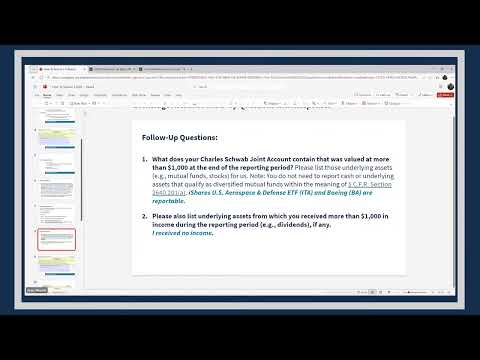
Using a submitted example listed only as a "Charles Schwab joint account," Wheeler demonstrated how to proceed: reviewers must first clarify the account type (brokerage, retirement, HSA, managed, margin, or custodial accounts such as UGMA/UTMA) and then obtain a list of qualifying underlying assets. She noted OGE part‑one reporting requires listing each underlying asset individually worth more than $1,000 at the end of the reporting period and any asset that produced more than $1,000 in income, while cash and diversified mutual funds generally need not be listed as underlying assets.
When the filer later identified the brokerage account holdings as iShares US Aerospace and Defense ETF (ticker ITA) and Boeing (ticker BA) and reported no income from them during the period, Wheeler explained how to apply statutory conflict‑of‑interest standards. Under 18 U.S.C. 208, she said, "because shares of stock represent an ownership in a company, a particular matter that has a direct and predictable effect on the issuing company is treated as having a direct and predictable effect on the financial interest of the shareholders." For ETFs, she explained, reviewers must examine the ETF’s underlying holdings to identify whether a particular matter would have a direct and predictable effect on those underlying companies.
Wheeler also reviewed a submitted entry for a family farm listed as "Smith Family Farm." She said a farm may be reported either as a business or as farmland/passive interest depending on facts, and that part‑one reporting thresholds (value greater than $1,000 or income greater than $1,000) apply. Reviewers should record the farm name, location (city/state or county/state), business activity (crops or livestock), and the filer’s ownership type (for example, sole proprietor or general partner). She warned that conflict‑of‑interest analyses for farms are fact specific and should consider whether the employee could act to affect crop or livestock prices, the geographic relationship between the farm and government activities, any contracts between the farm and the employee’s agency, and whether the farm participates in agency‑administered subsidy programs.
Wheeler reminded attendees that other statutes may restrict post‑employment or representational activities: 18 U.S.C. 205 generally bars a federal employee from representing third parties before the U.S. government in matters where the U.S. has a direct and substantial interest, and 18 U.S.C. 203 prohibits seeking or receiving compensation for representational services before the government. She pointed reviewers to OGE legal advisories (for example, LA‑1509 and LA‑2014), the IEG video library, and the public financial disclosure guide for additional detail.
On trusts, Wheeler advised that "there are a lot of different kinds of trusts" and that reviewers must ask multiple follow‑up questions to determine the filer’s relationship to the trust and what it holds; she recommended using the confidential guide, the conflicts collection entry on legal entities, and IEG trust resources when the facts are complex.
Wheeler closed by reiterating the 222 framework and encouraging attendees to consult the cited OGE resources and to gather missing facts from filers rather than guessing. She asked participants to complete a short survey on the course page to guide future trainings ahead of filing season.