Get Full Government Meeting Transcripts, Videos, & Alerts Forever!
Get email alerts on the School Nutrition Disabilities topic
No spam. Unsubscribe anytime.
Tennessee DOE trains school nutrition staff on accommodating students with disabilities, highlights new milk substitute and medical-statement policies
Summary
A Tennessee Department of Education webinar reviewed ADA standards, procedural safeguards, medical-statement requirements, and recent USDA/state updates allowing registered dietitians prescriptive authority and a new lunch-only flexibility for non-dairy milk substitutes.
Trista Snider, Northwest Regional Nutrition Consultant for the Tennessee Department of Education’s School Nutrition Program, led an online training for school nutrition staff on how to accommodate students with disabilities in school meal programs and on recent policy changes affecting milk substitutes and medical-statement authority.
Snider opened by defining disability under the Americans with Disabilities Act and advising that diet restrictions related to bodily functions (digestive, bowel, endocrine) can qualify as disabilities requiring reasonable accommodations. She told attendees that SFAs should not delay providing accommodations while collecting documentation and recommended a team approach — including 504 teams, school nurses, and nutrition staff — to implement safe, confidential processes. “If this happens, it's really important that you contact the parent or guardian immediately and get as much information as possible so that you can start the request,” she said.
The webinar stressed when a written medical statement is required: any requested modification that alters the USDA meal pattern (for example, substituting water for required milk) requires a medical statement signed by a professional with prescriptive authority. Snider reviewed SP07-2025 guidance on the content a medical statement must include — an explanation of the disability, how it restricts the diet, foods to avoid and recommended alternatives — and highlighted a Tennessee expansion of prescriptive authority to include state-licensed health care professionals and, more recently, registered dietitians.
On milk substitutes, Snider discussed a USDA update (SP01-2026) giving SFAs the flexibility to offer nutritionally equivalent non-dairy beverages to all students at lunch without notifying the state agency; when offered to all students for lunch, SFAs need not submit the alternate milk waiver or require written parental requests for non-disability reasons. “If the SFA offers a nutritionally equivalent non dairy beverage to all students, you are no longer required to notify the state agency,” she said. She cautioned that non-equivalent beverages and substitutions for disability reasons still require a medical statement that meets the regulatory nutrient table.
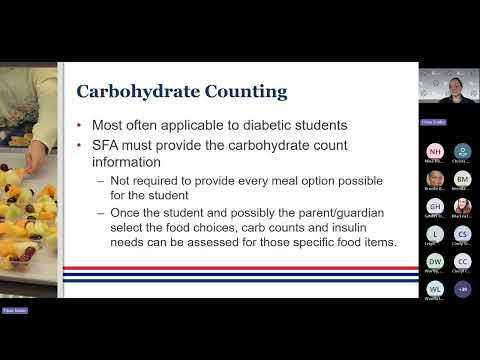
Practical measures covered included carbohydrate counts for students with diabetes, portion and texture modifications (pureed, ground, thickened liquids), label review for hidden allergens, EpiPen training, HACCP and cross-contact prevention, and sample forms districts can adapt. Snider emphasized confidentiality and records maintenance: staff should only share medical information on a need-to-know basis and forms should be dated so SFAs can identify the current prescription.
Funding guidance included that SFAs cannot charge families for reasonable meal modifications; the additional cost may be covered from the nonprofit food service account, LEA general fund, or, where appropriate, special education funds tied to an IEP or 504 plan. She reminded attendees that meals outside the USDA meal pattern and lacking appropriate documentation generally are not eligible for federal reimbursement and recommended that districts set explicit timeframes for temporary accommodations while parents secure required documentation.
Snider closed by urging districts to review and update policies and procedures, train staff, assign responsibility for special-diet management, and coordinate with parents and IEP/504 teams. Presenters said they will send a follow-up email with the recording, PowerPoint, and a legal-team answer to a chat question about dietitians submitting meal modifications.
The session included a short Q&A in chat; attendees were asked to complete an evaluation. The training served as both operational guidance for school nutrition staff and an explanation of recent policy clarifications affecting medical-statement authority and milk-substitute procedures.