Get Full Government Meeting Transcripts, Videos, & Alerts Forever!
Get email alerts on the Capital Plan topic
No spam. Unsubscribe anytime.
Spring‑Ford administration recommends $103.5M plan to add full‑day kindergarten, shift to a 6–8 middle school
Summary
District leaders recommended Option 4A — full‑day kindergarten (K–5), conversion to a 6–8 middle school and a 10‑year, $103.5 million facilities program — with phased borrowing and a planned redistricting process; the board voted 9–0 at the work session to advance action items to the March 26 meeting.
The Spring‑Ford Area School District on Wednesday presented a recommended capital plan that would add full‑day kindergarten (K–5), convert the district to a 6–8 middle‑school model and start a 10‑year renovation program estimated at $103.5 million.
Superintendent Dr. Scanlon said the administration is recommending Option 4A after two years of facilities study and updated demographic work. "Our final recommendation is adopt 4A of the facilities plan," he said, describing a program that would build slightly larger elementary additions, convert the 5‑6‑7 building to a 6–8 middle school and close the district's century‑old eighth‑grade center in fall 2030 under the proposed timeline.
The plan has three stated goals: provide full‑day kindergarten, reduce the number of grade transitions students experience, and begin a $78.6 million baseline program to renovate district buildings. Dr. Scanlon and business staff said Option 4A would add roughly $25 million beyond that baseline to implement programmatic changes and elementary additions.
Dr. Murray, who outlined the full‑day kindergarten curriculum and benefits, said the change would increase core reading and math instructional time and allow daily access to specials and intervention time. "With full‑day kindergarten, students would gain the access to Ram Quest and library as well," she said, and noted research supporting academic and social‑emotional gains.
On the middle‑school model, Dr. Gardy recommended interdisciplinary teams, expanded advisory and MTSS supports, and daily specials and elective offerings for grades 6–8. The proposal would maintain two counselors per grade and dedicate planning time for teacher teams, she said.
Human resources projected additional staffing needs tied to the model change. Beth Lease, director of human resources, told the board the district would likely need six new classroom teachers, about 6.5 student‑support specialists, and four assistant principals as some elementary schools grow in size.
Finance staff outlined a phased financing plan the administration said would fund about $85 million of borrowing in four tranches: an approximately $10 million bank‑rated tranche in 2026, roughly $40 million in 2027, about $26.5 million in 2028, and a final ~$10 million bank‑rated tranche in 2030, supplemented by front‑end capital‑reserve use (approximately $3.5 million) and operating‑budget set‑asides to replace reserves over time. Mr. Fink said the district’s current debt‑service schedule places it in a position to issue new bonds without a large immediate tax spike.
The administration also described program assumptions for renovations — kindergarten bathrooms in classrooms, large‑group instruction spaces, small‑group rooms for special education and interventions — and recommended a target operating capacity of 83% to preserve flexibility for special‑education needs.
On schedule and next steps, Dr. Scanlon said design work would begin in April if the board moves forward, a redistricting committee would be formed in August and phased bidding would begin in 2027 with elementary projects first; the administration proposed a two‑year phase‑in with fall 2029 and fall 2030 milestones for feeder‑pattern and building changes.
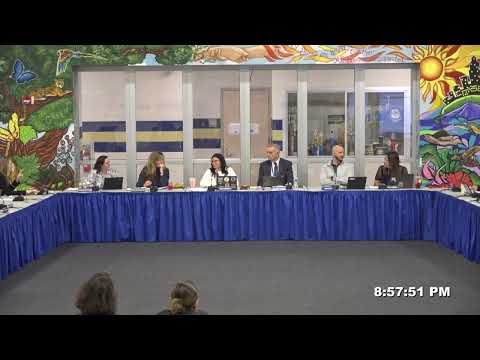
At the work session the board moved and seconded two action items related to the capital plan and other agenda matters and voted by voice; the chair recorded the motion as carrying 9–0. The motion text and formal agenda items will appear on the board’s March 26 regular meeting agenda for final action.
If the plan is approved, administration recommended building in alternate bids for optional items (for example, an auditorium design estimated at about $14.5 million) so the board could choose additions during the construction process.
The district will present detailed redistricting options and staffing and operating‑cost impacts in committee and at future meetings before implementation. The administration said it expects some operating costs to rise (they estimated a net operating increase in the range of $3.1–$3.2 million once the program is fully implemented) but also projected savings from reduced charter‑school payments and energy efficiencies when older buildings are taken off line.
The board scheduled formal action on the capital plan for its March 26 meeting; if approved, design work and committee formation would follow on the timeline described by administration.