Get Full Government Meeting Transcripts, Videos, & Alerts Forever!
Get email alerts on the Solar Ordinance topic
No spam. Unsubscribe anytime.
Appomattox supervisors adopt stronger rules for utility‑scale solar, add battery and decommissioning requirements
Summary
The board approved amendments to Appomattox County Code chapter 19.6‑97 to strengthen requirements for utility‑scale solar projects, including added review for battery energy storage, decommissioning, larger buffers and new setbacks; supervisors asked planning staff to consider capacity limits for residential batteries.
At a public hearing on zoning amendments, the Appomattox County Board of Supervisors approved revisions to chapter 19.6‑97 of the county code regulating utility‑scale solar energy farms.
The ordinance amendments, recommended 6–1 by the planning commission, add clarification for battery energy‑storage facilities, require studies (natural heritage, cultural resources, glint and glare, water resources and emergency‑services assessments), strengthen decommissioning and financial‑security provisions, increase buffer and setback distances (including setbacks from water bodies and floodplains), and add a height limitation and language supporting pollinator habitats.
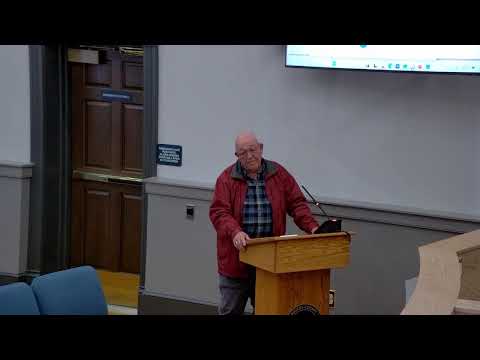
During the hearing, George Alman — who said he had been involved in local solar discussions for years — supported the amendments and emphasized the need for county authority over decommissioning costs and oversight. Robin Fouts complimented the draft ordinance but urged the board and planning staff to require plain‑language disclosure on whether battery systems are grid‑interactive or strictly for onsite backup, to add enforceable site‑specific noise limits for battery installations, and to require shielded lighting plans to reduce nighttime impacts.
Supervisor Simpson moved to approve the ordinance as submitted by the planning commission; Reverend Jones seconded. The motion carried on a voice vote. Supervisors asked staff to return battery‑related comments to the planning commission for further evaluation, and one supervisor asked the planning commission to consider whether a kilowatt‑hour or capacity limit should be placed on residential battery systems.
The amendments are intended to give the county stronger permitting tools as utility‑scale and battery projects increase regionally. The transcript does not record subsequent administrative timelines or an effective date in the provided excerpt.