Get Full Government Meeting Transcripts, Videos, & Alerts Forever!
Get email alerts on the Zoning Case Pride Of The Prairie topic
No spam. Unsubscribe anytime.
Will County staff backs Earthrise’s 600 MW ‘Pride of the Prairie’ solar plan as residents press concerns
Summary
Will County staff recommended approval of Lincoln Solar Energy LLC’s Pride of the Prairie special‑use permit and variances for a roughly 600 MW, ~6,100‑acre solar project, but the hearing drew heavy public comment raising wetlands, drainage, property‑value and process concerns; the hearing was recessed to March 31.
County planning staff recommended the Will County Planning & Zoning Commission approve Lincoln Solar Energy LLC’s special‑use permit request for ‘Pride of the Prairie,’ a commercial solar energy facility proposed by Earthrise Energy that the applicant says would generate up to 600 megawatts across roughly 6,100 acres.
Kelly Kruinski, the county’s presenter, told the commission that the application covers 96 tax parcels and 46 property owners and requests about 195 variances, chiefly to allow native pollinator vegetation to reach about 36 inches and to reduce mowing frequency from five times per season to one. The staff report attached multiple studies and input from local agencies, and recommended approval of the special‑use permit along with the variances, while removing a previously proposed condition requiring NRI field inspections at permitting time.
Why it matters: The size and scope make this one of the largest proposed utility‑scale solar projects in the county. County staff said the proposal complies with the state siting law and noted an Agricultural Impact Mitigation Agreement will be required by the Illinois Department of Agriculture, but a large group of townships, environmental committees and nearby residents said more technical review is necessary before any final action.
Applicant case and benefits Ben Jacobe, attorney for Lincoln Solar Energy LLC (Earthrise’s project vehicle), outlined the formal request and introduced the development team. He said the project would include roughly 17,000 tracking solar panels, arrays generally south of the village of Manhattan, medium‑voltage interconnection using an existing peaker plant, and access roads and fenced arrays designed to meet applicable electrical and safety codes. “We’re asking tonight for this commission to recommend approving a special use permit to construct and operate a commercial solar energy facility,” Jacobe said.
Developer representatives highlighted projected local economic impacts. Rob Kalbas, Earthrise’s director of development, told the commission the company expects the project to produce an estimated $3.5 million in new property tax revenue in year one and about $81 million over a 35‑year project life; the application materials estimate about $1.8 million would go to Peotone School District 207‑U in year one. The applicant’s economic study also estimated roughly 969 in‑county construction jobs and dozens of ongoing operations positions.
Technical and environmental claims County staff and project witnesses said technical reports submitted with the application—glare, sound, and traffic route plans—predict compliance with Illinois Pollution Control Board standards and that impacts to adjacent properties would be limited. Earthrise’s environmental director (self‑identified in the hearing) described a broad program of surveys and avoidance, saying the team identified wetlands, archaeological resources and habitat features and intends to design around them and follow the state’s pollinator‑friendly guidance.
Dr. Chris Olsen, an environmental health scientist retained by the applicant, addressed public questions about electromagnetic fields and panel combustion, saying measured magnetic fields at fence lines are comparable to everyday household background levels and that panels typically melt rather than “off‑gas” toxic liquids during rare fires. He added that galvanized steel piles can show only minor, localized zinc leaching.
Outstanding procedural and technical objections Opponents—residents, township boards, a watershed committee and private attorneys—pressed multiple technical and procedural objections at the hearing: they said critical materials and federal/state jurisdictional reviews (for waters of the U.S. / Army Corps determinations and some wetland delineations) were missing from the public record at the time of the hearing; they questioned whether the preliminary site development materials are sufficient to map panels and avoid sensitive hydrology; and they argued that long‑term maintenance and enforcement mechanisms (vegetation replacement, drain‑tile repair, monitoring) need clear, enforceable commitments.
Attorney Steve Becker, representing multiple adjacent property owners, urged the commission to treat the filing as incomplete, citing missing site‑development permit materials and outstanding jurisdictional wetland/Army Corps reviews. Watershed committee members said the project touches numerous watershed parcels and urged federal/state reviews before a county decision.
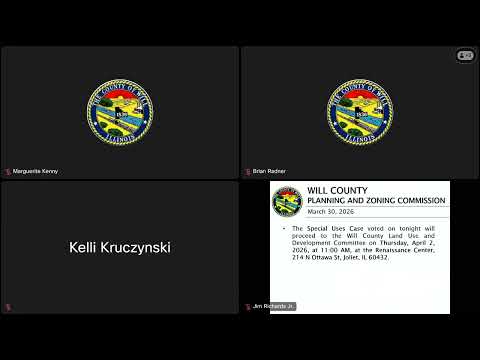
What happened procedurally Because public comment extended well past the scheduled hour, the commission recessed the hearing and voted to continue at 5:30 p.m. on March 31, 2026. No final zoning decision, motion to approve, or formal vote on the special‑use permit was taken on March 30.
Next steps The commission will reconvene to complete the hearing and consider any supplemental materials, response memos and further testimony. If the commission ultimately recommends approval, the matter will proceed to the county board for its decision per the county’s zoning procedures.