Get Full Government Meeting Transcripts, Videos, & Alerts Forever!
Get email alerts on the Qcdr Self Nomination topic
No spam. Unsubscribe anytime.
CMS lays out QCDR self‑nomination timeline, testing and posting requirements for measures
Summary
CMS PIQMMS staff told QCDR participants that self‑nominations for QCDR measures open July 1 and close Sept. 1, new measures require only face validity in their first year but must be fully tested in later years, and final specifications must be posted to the QPP Resource Library and on QCDR websites during the performance period.
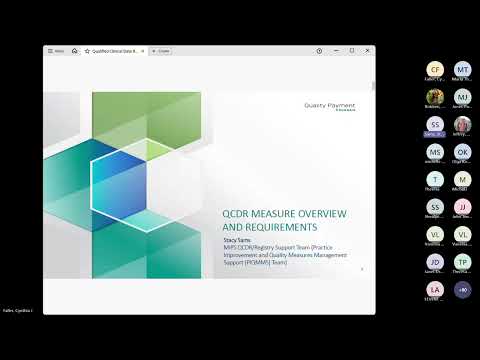
The Centers for Medicare & Medicaid Services’ Practice Improvement and Quality Measure Management Support Team (PIQMMS) told registries during a Feb. 16, 2026, webinar that the annual QCDR self‑nomination window opens July 1 and closes Sept. 1 and that CMS will review each submission for potential inclusion in MIPS.
Stacy Sams of PIQMMS said QCDRs must submit completed self‑nomination forms during that window and that only measures submitted in that timeframe will be reviewed. She noted that “substantive revisions are not allowed after self‑nomination closes,” and that any rejected measures will have a chance for reconsideration calls with CMS leadership. Finalized, approved specifications are published to the QPP Resource Library and QCDRs are given a 15‑day window to post the same specifications on their public websites.
The webinar emphasized a two‑stage testing expectation. New QCDR measures require face validity (expert subjective assessment) for their first year in the program, PIQMMS staff said, but measures that continue into a second performance year must be fully developed and tested at the clinician level. Marla Throckmorton explained the elements of full testing: measure‑score validity and reliability, patient or encounter‑level data‑element testing, and feasibility testing to confirm data elements are retrievable without undue burden or confidentiality concerns.
Presenters urged measure developers to prefer outcome and patient‑reported measures (including Patient‑Reported Outcome Performance Measures and Intermediate Outcomes) rather than measures that only capture a completed check or assessment. CMS said measures should demonstrate variability across clinicians and avoid concepts that are effectively duplicative of existing QCDR or MIPS measures.
The webinar also provided operational guidance for multi‑strata and multi‑performance rate measures, including examples of when QCDRs must submit multiple performance rates to CMS, when to aggregate strata into a single overall rate, and how CMS may calculate simple or weighted averages during benchmarking. Throckmorton summarized: QCDRs must identify which performance rate will be used for benchmarking at submission time.
Panelists highlighted practical steps for submitters: complete the Self‑Nomination Toolkit fields in full, run spelling and grammar checks before submitting, provide any available partial testing or performance data when full year data are unavailable, and, when borrowing a measure, include written permission from the owning QCDR with the self‑nomination form.
As a resource for developers, the PIQMMS team announced preview calls from Feb. 16 through May 29 (last day to request a call: May 15), asking QCDRs to submit measure specifications at least seven calendar days before the scheduled call. The team said the recording, transcript and slides will be published in early March on the QPP Webinar Library.
Next steps: QCDRs should complete environmental scans for duplicative concepts, prepare required testing and performance evidence ahead of the July 1‑Sept. 1 window, and consider scheduling preview calls to discuss measure specifics with CMS."