Get Full Government Meeting Transcripts, Videos, & Alerts Forever!
Get email alerts on the Housing Statutory Compliance topic
No spam. Unsubscribe anytime.
Wilsonville staff propose code changes to implement SB 974 and HB 4037, seek feedback on 100-foot notice, appeals and 10,000-sq-ft threshold
Summary
City staff outlined draft code amendments to comply with Senate Bill 974 and House Bill 4037 that would shift many residential reviews to staff-level administrative (class two) review, limit mailed notice to 100 feet for most projects under 500 units, restrict appeals of straight type-two residential projects to applicants, and propose raising the administrative-review cap for building changes to 10,000 square feet (with a 25% cap). Commissioners asked for clarifications on waivers, outreach, and equity impacts for small businesses.
Wilsonville’s Planning Commission spent its March 30 work session reviewing draft development-code amendments staff say are needed to comply with recent state legislation and to clarify local procedures.
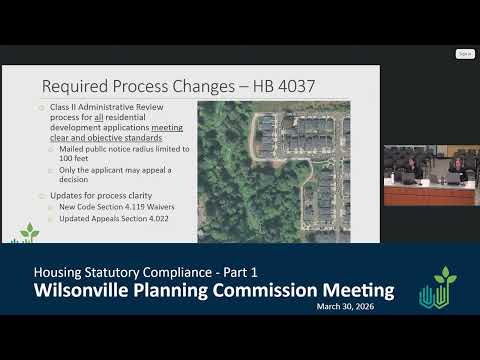
Senior planner Kim Rybold and consultant Heather Austin said the first phase of the Housing Statutory Compliance project implements requirements in Senate Bill 974 and House Bill 4037 and prepares the city to meet statutory deadlines. "There are three main components that we were wanting to address," Austin told commissioners, summarizing changes to review authority, mailed notice and appeals.
The most substantial procedural shifts staff proposed include: converting many residential applications that meet clear-and-objective standards to staff-level (class two) administrative review; adopting a 100-foot mailed-notice radius for most projects under 500 units (the statutory minimum cited by staff); and restricting appeals of straight type-two residential projects so that only the applicant may appeal those administrative decisions under HB 4037.
"The city is looking at having the 100 ft applicable citywide and project-wide for consistency," Austin said, explaining staff updated the proposed language to align with the new statute. Kim Rybold added that staff rewrote the appeals section so it would be clear which applications retain public appeal rights and which do not.
Staff also proposed raising the threshold for administrative review of modifications to existing buildings from 1,250 square feet (the current code cap) to a 10,000-square-foot cap while keeping the 25% limit in place. The change is intended to prevent small additions on very large buildings from triggering a full DRB hearing while ensuring larger, potentially impactful projects still receive broader public review. Commissioner Andrew Carr asked whether the city could "just use the 25%" rule rather than a flat cap; staff replied the cap prevents large absolute additions on very large buildings from proceeding administratively.
Commissioners pressed staff on which standards should remain ineligible for administrative waivers. Staff pointed out draft section 4.119 identifies higher-scrutiny standards that would "not be waived unless there is substantial evidence in the record" — including open-space standards for residential projects, minimum density and housing-variety rules, and minimum landscaping, screening and buffering standards. Staff said discretionary waiver paths (and their appeal rights) will remain available for instances where alternative approaches are supported by the record.
The draft package includes additional, non-substantive cleanups and clarifications: new definitions for "residential development" and "review authority," a more objective site-design-review approach for residential projects (while preserving subjective review for non-residential cases), a proposed one-year expiration for pre-application meetings, and suggested restructuring of the Development Review Board (consolidating panels into a single seven-member body with a quorum of four, effective in early 2027).
Several commissioners raised concerns about reduced mailed notice and public outreach. Staff acknowledged the 100-foot notice is largely statutory for many residential applications and proposed complementary outreach steps — such as site postings, an online list of administrative reviews and expanded Let’s Talk Wilsonville engagement tools — to increase transparency and public access to information.
No formal actions or votes were taken during the work session. Staff said they will incorporate the Planning Commission’s feedback, continue public outreach, and bring recommended code amendments to City Council next week, with final hearings planned in May and implementation tied to state deadlines (staff referenced an implementation date of July 1, 2027, for the first phase requirements).